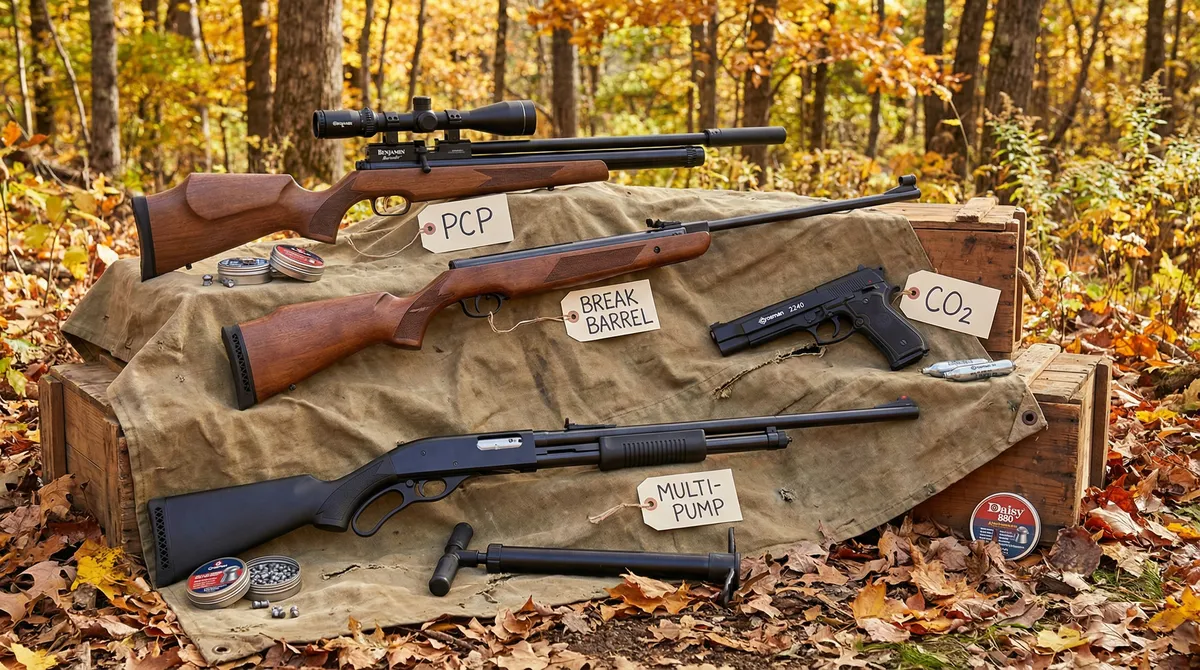
You have many choices for pellet guns, from Airsoft guns to traditional BB guns to powerful PCP air rifles. There are dozens of brands and models with a variety of features. When you’re making your first purchase, trying to make sense of all your options can be overwhelming. This comprehensive guide will help you understand everything you need to know about buying a pellet gun in 2026.
Types of Air Guns Explained
The first thing you need to understand is what the different types are and how they differ:
Traditional Pellet Guns vs. Airsoft
Pellet guns (also called air rifles, BB guns, or air guns) fire metal projectiles (lead, steel, or alloy) and can be used for target shooting, pest control, and hunting small game. They are capable of serious damage and should be treated like firearms.
Airsoft guns fire 6mm plastic BBs and are designed for recreational gaming (similar to paintball). They include an orange tip to distinguish them from real firearms and are not suitable for hunting or pest control.
BB Guns vs. Pellet Guns
While often used interchangeably, there’s a key difference:
-
BB guns fire spherical steel or copper-plated BBs (typically 4.5mm). Good for plinking but less accurate at distance.
-
Pellet guns fire diabolo-shaped lead pellets that are more aerodynamic and accurate. Better for precision shooting and hunting.
Power Sources: How Air Guns Work
Modern air guns use several different mechanisms to propel pellets:
Spring-Piston / Gas Ram
These are the most common and affordable air rifles. Cocking the barrel (break-barrel) or lever compresses a spring or gas ram. When you pull the trigger, the piston releases and pushes air behind the pellet.
Pros: No external air source needed, reliable, affordable
Cons: Single shot, some recoil, technique-sensitive
Best Example: Gamo Swarm Magnum 10X Gen 3i – Features a 10-shot magazine, solving the single-shot limitation while delivering up to 1,300 FPS.
Multi-Pump Pneumatic
These rifles require pumping a lever multiple times (typically 2-10 pumps) to compress air. More pumps = more power.
Pros: Variable power, no recoil, affordable, great for beginners
Cons: Slow between shots, requires effort to pump
Best Example: Crosman 1077 – A classic that’s been updated with modern features while remaining beginner-friendly.
CO2 Powered
These use disposable or bulk CO2 cartridges to propel pellets. Simply load a cartridge and shoot.
Pros: Easy to use, semi-automatic options available, no pumping
Cons: Ongoing CO2 costs, power affected by temperature
Best for: Casual shooters, those wanting semi-auto capability. For precision shooting with CO2 pistols, see our guide to the most accurate CO2 pistols.
Pre-Charged Pneumatic (PCP)
The pinnacle of air rifle technology. PCP rifles use a built-in air reservoir filled to 3,000-4,500 PSI. They deliver consistent, powerful shots with minimal recoil.
Pros: Most accurate, highest power potential, multiple shots per fill, nearly silent
Cons: Requires fill equipment (hand pump or tank), higher initial cost
Best Examples:
-
Air Venturi Avenger – Best value PCP on the market, user-adjustable power
-
Benjamin Marauder – The industry standard for hunting PCPs
-
Umarex Gauntlet 2 – Feature-rich with integrated suppression
Caliber Selection Guide
Air guns come in several calibers, each with different characteristics:
| Caliber | Best For | Characteristics |
|---|---|---|
| .177 (4.5mm) | Target shooting, plinking, pest birds | Flattest trajectory, highest velocity, most affordable ammo |
| .22 (5.5mm) | Small game hunting, pest control | Best all-around caliber, good energy retention |
| .25 (6.35mm) | Larger small game, pest control | More knockdown power, shorter effective range |
| .30+ (Big Bore) | Large game (where legal) | Requires powerful PCP, expensive ammo |
Our recommendation: If you can only have one air rifle, choose .22 caliber. It’s versatile enough for both target shooting and hunting.
Understanding Power: FPS vs. FPE
Don’t be fooled by FPS (feet per second) numbers alone. What matters more is foot-pounds of energy (FPE).
Example: A .177 pellet at 1,200 FPS produces about 14 FPE. A .22 pellet at 900 FPS produces about 18 FPE. The “slower” .22 is actually more powerful for hunting.
Power Guidelines by Use
-
Target shooting/plinking: Any power level works
-
Pest birds/rodents: 10-15 FPE minimum
-
Squirrels/rabbits: 15-20 FPE minimum
-
Larger game: 25+ FPE
What to Look For When Buying
1. Build Quality
Look for:
-
Solid stock (wood or quality synthetic)
-
Metal vs. plastic components in critical areas
-
Good trigger feel (adjustable is a plus)
-
Quality barrel (steel, not brass)
2. Accuracy Features
-
Rifled barrel (essential for pellets)
-
Adjustable sights or scope rails
-
Consistent velocity (especially important for PCPs)
3. Ergonomics
-
Proper length of pull for your size
-
Comfortable grip and cheek weld
-
Manageable weight for your intended use
Top 5 Pellet Guns for 2026
1. Air Venturi Avenger – Best Value PCP
The Air Venturi Avenger has revolutionized the budget PCP market. With user-adjustable power, a regulated action, and a Lothar Walther barrel, it delivers accuracy that rivals rifles costing three times as much. Available in .177, .22, and .25 calibers.
Why we love it: Incredible accuracy, adjustable everything, amazing price point
2. Gamo Swarm Magnum 10X Gen 3i – Best Break-Barrel
The Gamo Swarm Magnum 10X solves the break-barrel’s biggest weakness (single shot) with a 10-round rotary magazine. The IGT gas piston provides smooth cocking and consistent power. Perfect for those who don’t want to deal with air tanks or pumping.
Why we love it: 10-shot capability, no external air needed, powerful
3. Benjamin Marauder – Best Hunting PCP
The Benjamin Marauder has earned its reputation as the go-to hunting PCP. Quiet, accurate, and powerful enough for serious small game hunting. The regulated action provides consistent velocities throughout the fill.
Why we love it: Proven performance, excellent accuracy, quiet operation
4. Umarex Gauntlet 2 – Best Features
The Umarex Gauntlet 2 packs premium features into an affordable package: integrated suppressor, adjustable stock, large air tank, and excellent accuracy. Available in .22, .25, and .30 calibers.
Why we love it: Feature-rich, quiet, multiple caliber options
5. Crosman 1077 – Best for Beginners
The Crosman 1077 is the perfect entry-level air rifle. CO2 powered with a 12-shot rotary magazine, it’s simple to use and fun to shoot. Great for learning fundamentals before moving to more powerful rifles.
Why we love it: Affordable, easy to use, semi-automatic fun
Ammunition: Choosing the Right Pellets
Quality pellets matter as much as the rifle itself. Our top recommendations:
For Target Shooting
-
JSB Exact Diabolo – Gold standard for accuracy
-
H&N Field Target Trophy – Competition-grade consistency
For Hunting
-
H&N Baracuda Hunter Extreme – Expanding hollow points
-
JSB Hades – Devastating terminal performance
Legal Considerations
Air gun laws vary significantly by location. Before purchasing:
-
Check local ordinances about discharge within city limits
-
Verify age requirements (typically 18+ for purchase)
-
Understand hunting regulations if you plan to hunt
-
Some jurisdictions require background checks or permits
Getting Started
For beginners, we recommend:
-
Start with .22 caliber – Most versatile
-
Budget $200-350 – This gets you a quality rifle that will last
-
Invest in good pellets – Don’t cheap out on ammo
-
Add a quality scope – Open sights are fine, but a 3-9x40 scope improves accuracy dramatically
-
Practice at known distances – Learn your rifle’s trajectory
Check out our detailed guides:
Last updated: November 2026