
Last updated: June 2026
If your air rifle groups suddenly open up, your point of impact shifts when you move your head behind the scope, or you can’t seem to get crisp focus on close targets — you’re not losing your touch. You’re fighting parallax error, and it’s the single most misunderstood concept in air rifle optics.
Unlike firearm shooters who typically engage targets at 100 yards or more, airgunners regularly shoot from 10 to 75 yards. That close-range envelope is exactly where parallax error wreaks the most havoc. A scope set up perfectly for a centerfire rifle at 100 yards can throw your .177 pellet 2 inches off at 25 yards — purely from parallax.
This complete guide covers everything you need to know about air rifle scope parallax adjustment: what parallax actually is, why it matters more for airguns than firearms, how to adjust it properly, and which parallax free air rifle scope options are worth your money in 2026.
What Is Parallax (And Why Should You Care)?
Parallax is an optical phenomenon that occurs when the target image and the reticle are not focused on exactly the same focal plane inside your scope. When these planes don’t align, moving your eye even slightly behind the scope causes the reticle to appear to move relative to the target — even though the rifle hasn’t budged.
The result? Inconsistent point of impact, mysterious flyers, and groups that look like a shotgun pattern instead of a tight cluster.
The Simple Explanation
Hold your thumb up at arm’s length and look at a distant object. Close one eye, then the other. Your thumb appears to “jump” relative to the background. That’s parallax. Inside your scope, the same thing happens when the reticle and target image aren’t on the same plane.
Why Airgunners Suffer More
Most centerfire scopes are factory-set to be parallax-free at 100 or 150 yards. That’s fine for deer hunting, but useless when you’re shooting starlings at 18 yards in the backyard. At distances under 50 yards, the parallax error from a non-adjustable scope can easily exceed the size of your target’s vital zone.
This is why adjustable parallax isn’t a luxury for airgunners — it’s a requirement for serious accuracy.
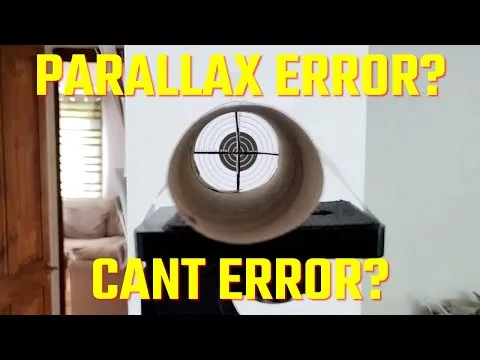
HFT Shooter’s video above does an excellent job demonstrating what parallax error looks like at the bench. Worth watching before you adjust your own scope for the first time.
How Parallax Affects Air Rifle Accuracy
Let’s get specific. Here’s how much parallax error can move your point of impact at common airgun distances when using a scope set to 100 yards:
| Target Distance | Typical Parallax Error | Practical Impact |
|---|---|---|
| 10 yards | 1.5 - 2.5 inches | Misses small targets entirely |
| 25 yards | 0.75 - 1.5 inches | Opens groups, kills pesting accuracy |
| 35 yards | 0.5 - 1.0 inches | Marginal hunting accuracy |
| 50 yards | 0.25 - 0.5 inches | Acceptable for plinking |
| 75 yards | 0.1 - 0.25 inches | Minimal effect |
| 100 yards | 0 inches | Parallax-free (factory setting) |
Notice the pattern? The closer your target, the bigger the parallax error. This is the exact opposite of where most shooters expect optical problems.
Real-World Example
You’re shooting a .22 PCP at a 1-inch spinner at 25 yards. Your scope is a fixed-parallax 3-9x40 set for 100 yards. You shoulder the rifle slightly inconsistently, putting your eye 1/8 inch off-center behind the scope. The reticle appears to be on the target, but the rifle is actually pointed an inch high and to the right. You miss.
Frustrating? Absolutely. Avoidable? Completely — with the right scope and adjustment technique.
Types of Parallax Adjustment Systems
Not all parallax-adjustable scopes are created equal. There are three primary systems on the market, and each has trade-offs.
Adjustable Objective (AO)
The AO system places a rotating ring at the front (objective) bell of the scope. You rotate this ring to focus the target image at your specific distance. AO scopes typically have distance markings (10, 15, 20, 25, 30, 40, 50, 100 yards, infinity).
Pros:
- Generally less expensive
- Mechanically simple and reliable
- Common in dedicated airgun scopes
Cons:
- Requires reaching forward to adjust
- Can be difficult to fine-tune while shooting
- Often harder to use prone or in awkward positions
Side Focus (SF)
The side focus system places the parallax adjustment as a third turret on the left side of the scope body (opposite the windage turret). You stay in your shooting position and turn the wheel without breaking position.
Pros:
- Adjust without leaving your shooting position
- Faster to fine-tune
- Preferred for field target and benchrest
Cons:
- Typically more expensive
- More mechanical complexity
- Side wheel can snag on gear
Fixed Parallax
Some scopes have no adjustment — they’re factory set to a specific distance, usually 35 yards (airgun scopes) or 100 yards (firearm scopes).
Pros:
- Cheapest option
- Simpler optics
- Works if you only shoot at one fixed distance
Cons:
- Inflexible
- Significant errors outside set distance
- Not recommended for serious airgunning
How to Adjust Parallax on an Airgun Scope
Here’s the step-by-step process I use every time I set up a new scope or change shooting distances significantly.
Step 1: Set Your Reticle Focus First
Before you touch parallax, make sure your diopter (the eyepiece focus ring) is properly set for your eye. Point the scope at a blank wall or clear sky, glance through quickly, and adjust the eyepiece until the reticle is razor sharp. Don’t stare — your eye will compensate and give you false sharpness. Quick glances only.
This step is permanent for your vision. Once set, leave it alone.
Step 2: Mount the Rifle on a Stable Rest
Sandbags, a bipod, or a dedicated rest. The rifle must not move during adjustment. Aim at a target at your chosen distance.
Step 3: Set the Magnification
Use the magnification you’ll actually shoot at. Parallax adjustment is technically magnification-dependent on some scopes, so adjust at your real shooting power.
Step 4: Rotate the Parallax Adjustment
If using AO, rotate the objective ring. If using SF, turn the side wheel. Stop when the target image appears sharp and crisp.
Step 5: The Head Movement Test
This is the critical verification step that most shooters skip:
- Get the target sharp in the scope
- Without touching the rifle, move your head slightly up, down, left, and right behind the scope
- Watch the reticle relative to the target
- If the reticle moves on the target → parallax is NOT eliminated → adjust further
- If the reticle stays glued to the target regardless of head position → parallax is eliminated ✓
This head-movement check is the only reliable way to confirm true parallax elimination. Distance markings on AO/SF scopes are approximate at best.
Rick Eutsler at AirgunWeb covers scope height effects in the video above, which works hand-in-hand with parallax to determine your real point of impact. Highly recommended for new scope owners.
Best Parallax-Adjustable Air Rifle Scopes for 2026
After testing dozens of scopes over the years, these are the models I recommend across different budget tiers. All have proven AO or SF parallax systems suited specifically for airgun ranges.
Best Budget Pick: UTG 3-9x32 1” BugBuster Scope
The UTG 3-9x32 BugBuster is the gateway parallax-adjustable scope for new airgunners. The adjustable objective ring focuses from 3 yards (yes, three) out to infinity, which is genuinely useful for backyard pest control work where you might be shooting at sparrows on the bird feeder.
Specs:
- Magnification: 3-9x
- Objective: 32mm
- Tube: 1 inch
- Parallax: AO, 3 yards to infinity
- Reticle: Mil-Dot illuminated
- Length: 8.2 inches
The illuminated reticle (red/green) helps in low light, and the compact 8-inch length suits short airguns like the Benjamin Marauder pistol or any youth-sized rifle. For under $100, it’s hard to beat.
Best Mid-Range AO Scope: Hawke Vantage 3-9x40 AO
The Hawke Vantage 3-9x40 AO hits the sweet spot for serious recreational airgunners. Hawke designs their reticles specifically for the looping trajectory of airgun pellets, and the AO focus works smoothly from 10 yards to infinity.
Specs:
- Magnification: 3-9x
- Objective: 40mm
- Tube: 1 inch
- Parallax: AO, 10 yards to infinity
- Reticle: Mil-Dot or Half Mil-Dot
- Length: 12.6 inches
Hawke’s glass is noticeably clearer than budget Chinese scopes, and the turrets click positively. This is the scope I recommend for most adult shooters with a quality break-barrel or budget PCP.
Best Side Focus: UTG 4-16x44 30mm Compact Scope
The UTG 4-16x44 30mm Compact Scope with AO — despite the AO in the name, modern versions use side focus — delivers serious magnification and parallax control in a surprisingly compact package. The 30mm tube provides generous windage and elevation adjustment range, which matters for high-magnification shooting.
Specs:
- Magnification: 4-16x
- Objective: 44mm
- Tube: 30mm
- Parallax: Side focus, 10 yards to infinity
- Reticle: EZ-TAP illuminated Mil-Dot
- Length: 10.6 inches
This is the scope I mount on dedicated target rifles and longer-range PCPs. The 16x top end lets you hold precise aim points at 75+ yards.
Best Premium Pick: Athlon Optics Argos BTR GEN2 6-24x50
The Athlon Argos BTR GEN2 6-24x50 brings tactical-grade features to airgun shooting. The first focal plane reticle, exposed turrets with zero stop, and parallax adjustment from 10 yards make it ideal for serious target shooters and field target competitors.
Specs:
- Magnification: 6-24x
- Objective: 50mm
- Tube: 30mm
- Parallax: Side focus, 10 yards to infinity
- Reticle: FFP Mil illuminated
- Length: 13.9 inches
At this price point, you’re getting glass quality and mechanical precision that rivals scopes costing twice as much. If you’re shooting at extended ranges or competing, this is the value champion.
Best Compact Option: Bushnell Banner 2 3-9x40
The Bushnell Banner 2 3-9x40 is a solid traditional choice. While not technically AO on most variants, the “Dawn-to-Dusk” coating provides excellent low-light performance for that prime morning/evening pest control window.
Specs:
- Magnification: 3-9x
- Objective: 40mm
- Tube: 1 inch
- Parallax: AO version available
- Reticle: Multi-X or DOA
- Length: 12 inches
Make sure you order the AO variant specifically — the standard Banner 2 is parallax-fixed at 100 yards.
Scope Comparison Table
| Scope | Magnification | Tube | Parallax Type | Min Parallax | Best For |
|---|---|---|---|---|---|
| UTG BugBuster | 3-9x32 | 1” | AO | 3 yards | Pest control, beginners |
| Hawke Vantage AO | 3-9x40 | 1” | AO | 10 yards | All-around airgun use |
| UTG 4-16x44 | 4-16x44 | 30mm | Side Focus | 10 yards | Target, longer range |
| Athlon Argos BTR | 6-24x50 | 30mm | Side Focus | 10 yards | Competition, precision |
| Bushnell Banner 2 AO | 3-9x40 | 1” | AO | 10 yards | Low light, hunting |
Common Parallax Mistakes to Avoid
After years of helping new airgunners set up scopes, these are the mistakes I see repeatedly:
Mistake 1: Trusting the Distance Markings
The yardage numbers etched on your AO ring or side wheel are factory approximations. Manufacturing tolerances, temperature, and your specific eye geometry all affect the true parallax-free point. Always verify with the head-movement test, not by setting the marking to “30” because your target is at 30 yards.
Mistake 2: Ignoring Magnification Effects
On many scopes, the effective parallax changes slightly with magnification. If you sight in at 9x but hunt at 4x, you may notice slight shifts. Adjust at your hunting magnification when it matters.
Mistake 3: Setting Reticle Focus Wrong
If your diopter isn’t properly adjusted for your eye, no amount of parallax adjustment will give you a sharp picture. Your eye will fight the scope, leading to fatigue, headaches, and inconsistent shooting. Set the eyepiece first, then leave it alone.
Mistake 4: Adjusting While Looking Through the Scope
When setting your diopter, don’t stare through the scope while turning the eyepiece. Your eye accommodates rapidly and gives you false feedback. Use brief 1-2 second glances at a blank background.
Mistake 5: Buying a Firearm Scope for Airguns
Many quality firearm scopes can’t focus closer than 50 yards. If you’re shooting at 25 yards, you’ll never eliminate parallax — the adjustment range simply won’t reach. Always buy a scope rated for airgun distances (10 yards or closer minimum focus).
Parallax-Free vs Parallax-Adjustable: What’s the Difference?
A “parallax free air rifle scope” doesn’t actually mean zero parallax exists. It means parallax has been eliminated at one specific distance through factory setting. The scope is parallax-free at that distance but exhibits parallax error at all other distances.
A parallax-adjustable scope lets you move the parallax-free point to match your current target distance. This is what you want for airgun shooting where target distances vary widely.
For a deeper look at related accuracy factors, check our guide on .177 vs .22 caliber air rifle selection — caliber choice interacts with scope selection in important ways.
While the video above focuses on firearm long-range shooting, the parallax adjustment principles Ryan Cleckner demonstrates apply directly to airgun scope work — particularly the head-movement verification technique.
Mounting Considerations for Airgun Scopes
Picking a parallax-adjustable scope is only half the equation. The mounts matter just as much, especially on spring-piston airguns where two-way recoil (the unique back-and-forth recoil of spring guns) can shake conventional scope mounts loose.
Key mounting considerations:
- Use scope stops on dovetail rails to prevent rearward creep
- Choose airgun-rated mounts designed for spring piston recoil
- Check ring height to ensure objective bell clears the barrel
- Consider one-piece mounts for spring guns at higher power
Related reading: our air rifle barrel length legal guide covers some interactions between barrel length, mount selection, and accuracy.
Maintenance and Long-Term Care
Once your parallax-adjustable scope is set up properly, treat it well:
- Cover both ends when not in use — dust on the objective glass will frustrate any focus adjustment
- Avoid solvents on optical surfaces; use proper lens cleaner only
- Check mount screws monthly on spring-piston guns
- Re-verify zero seasonally as temperature affects internal optics
- Don’t over-tighten the AO ring or SF wheel — finger-tight is correct
For more on selecting equipment from quality manufacturers, see our reviews of the Air Arms premium PCP lineup and the Beeman brand catalog.
Frequently Asked Questions
What does parallax adjustment do on an air rifle scope?
Parallax adjustment focuses the reticle and the target image onto the same optical plane inside the scope. This eliminates apparent reticle movement when your eye shifts behind the scope, dramatically improving accuracy — especially at airgun distances under 50 yards.
Do I need parallax adjustment for a 10-meter air rifle?
Yes, but only if your scope’s parallax setting can’t focus close enough. Many 10-meter target shooters use diopter sights instead of scopes for this reason. If you’re using a scope, you need adjustable parallax that focuses to at least 10 yards.
What is parallax error in scopes?
Parallax error is the apparent shift of the reticle against the target when your eye moves behind the scope. It occurs when the target image and reticle are not on the same focal plane. The closer the target, the worse the error becomes on a fixed-parallax scope.
Is side focus better than adjustable objective?
Side focus is generally more convenient because you can adjust without leaving your shooting position. AO scopes require reaching forward to the objective bell. Optically, both can achieve the same precision — choose based on your shooting style and budget.
Can parallax cause inaccuracy?
Absolutely. Parallax error is a leading cause of unexplained inaccuracy in air rifle shooting. At 25 yards, parallax error from a fixed 100-yard scope can move your point of impact 1-1.5 inches — enough to miss small pest control targets entirely.
What distance should I set my parallax to?
Set parallax to match your actual target distance. Use the head-movement test to verify rather than trusting the etched markings. For variable-distance hunting, set it for your most likely shot distance, then adjust as needed.
How do I know if my scope has parallax problems?
Mount the rifle on a stable rest, aim at a target, and move your head side to side behind the scope without touching the rifle. If the reticle appears to move on the target, you have parallax error. Adjust your parallax setting and retest until the reticle stays glued to the target regardless of head position.
Does parallax change with magnification?
On most scopes, yes — slightly. Adjust parallax at the magnification you’ll actually shoot at. Higher magnifications make parallax error easier to see, which is why precision shooters often use 12-24x scopes.
Final Thoughts: Why Parallax Adjustment Is Non-Negotiable
If you take air rifle accuracy seriously — whether for hunting, pest control, target shooting, or competition — a parallax-adjustable scope isn’t optional equipment. It’s the difference between consistent groups and frustrating mystery flyers.
Start with a quality AO or SF scope rated for airgun distances (10 yards minimum focus), set your diopter properly, verify parallax with the head-movement test, and you’ll see immediate accuracy improvements. The principles are simple; the discipline to apply them every time you shoot is what separates good airgunners from great ones.
For most adult airgunners, the Hawke Vantage AO or UTG 4-16x44 hit the price-performance sweet spot. Budget-conscious shooters and youth setups do well with the UTG BugBuster. Serious competitors should consider the Athlon Argos BTR.
Whichever you choose, take the time to learn proper parallax adjustment. Your groups will thank you.
This article contains affiliate links. If you make a purchase through these links, we may earn a commission at no extra cost to you. This helps support the site and allows us to continue providing helpful content.