Last updated: January 2026
If you’ve ever fired an air rifle in your backyard and worried about disturbing the neighbors, you already know why air rifle moderators (also called silencers or suppressors) are essential accessories for many shooters. While air rifles are significantly quieter than firearms, they still produce enough noise to be problematic—especially high-powered PCP rifles that can exceed 100 decibels.
The good news? The right air rifle suppressor can reduce report by 20-30 decibels, transforming a loud crack into a quiet puff. Whether you’re hunting, practicing pest control, or just enjoying backyard plinking, a quality moderator makes shooting more pleasant for you and everyone around you.
This guide covers everything you need to know about air rifle moderators and silencers in 2026, including how they work, what to look for, and our top recommendations across different budgets and rifle types.
What is an Air Rifle Moderator?
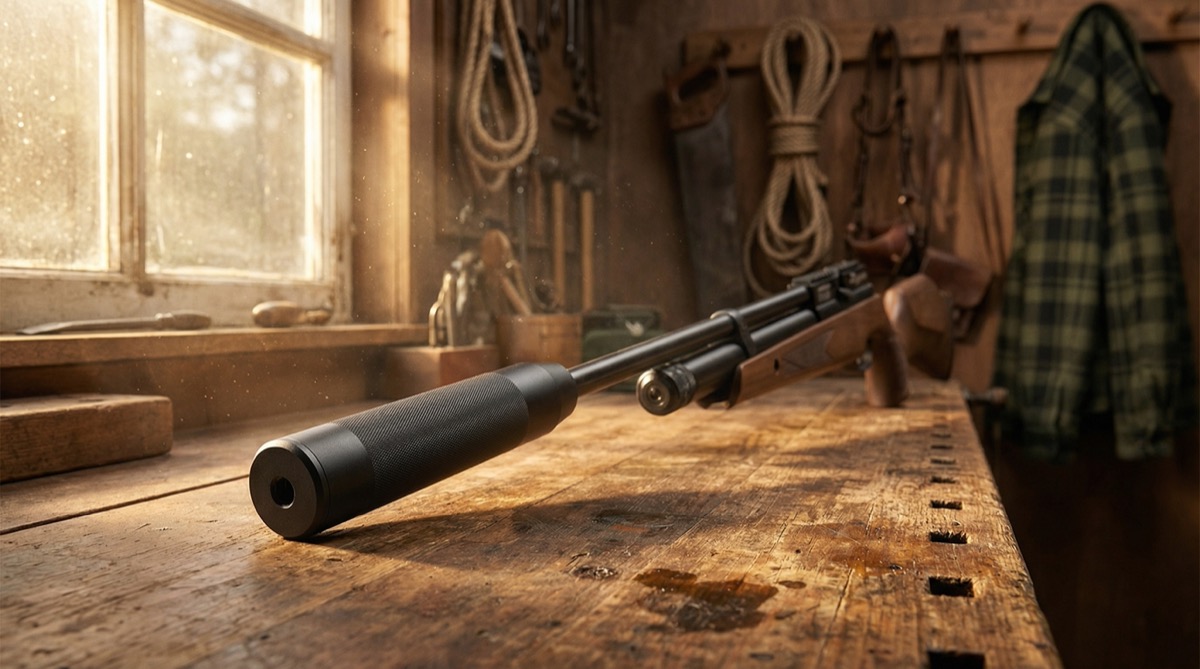
An air rifle moderator (also called a silencer or suppressor) is a tubular device that attaches to the end of your barrel to reduce muzzle report. Unlike firearm suppressors—which are heavily regulated in the United States—air rifle moderators are completely legal to own and use without special licensing or tax stamps.
How Air Rifle Moderators Work
Air rifle moderators use internal baffles, chambers, and sound-absorbing materials to disrupt and dissipate the high-pressure air that exits the barrel behind the pellet. Here’s what happens:
- Pellet exits barrel: High-pressure air follows the pellet out of the barrel
- Expansion chambers: The moderator provides space for this air to expand and slow down
- Baffle disruption: Internal baffles redirect airflow and create turbulence
- Sound absorption: Felt, foam, or mesh materials absorb sound energy
- Gradual release: Air exits the moderator more slowly and quietly
The result is a significant reduction in the sharp “crack” that occurs when compressed air rapidly expands at the muzzle.
Spring-Piston vs. PCP Moderators
The type of air rifle you own determines what kind of moderator you need:
PCP (Pre-Charged Pneumatic) Rifles: These benefit most from moderators because they release high-pressure air with each shot.
Spring-Piston Rifles: These generate most of their noise from the piston movement and spring vibration inside the rifle, not from muzzle blast. A moderator still helps by reducing the air release noise, but won’t eliminate the mechanical “twang” of the powerplant. Expect a 10-15 dB reduction rather than 20-30 dB.
CO2 Rifles: Similar to PCPs, CO2 rifles benefit significantly from moderators since most of their noise comes from gas release at the muzzle.
Legal Considerations
You can buy, own, and use them freely without special permits. However, keep these points in mind:
- Never use an airgun moderator on a firearm: This would be illegal manufacturing of a firearm suppressor
- Check local ordinances: Some cities restrict air rifle discharge regardless of noise levels
- Hunting regulations: Verify that moderators are allowed for hunting in your state
- International buyers: Laws vary significantly by country—check your local regulations
For more on where you can legally shoot air rifles, see our guide on air rifle hunting regulations by state.
What to Look for in an Air Rifle Moderator
Not all moderators perform equally. Here are the critical factors to consider when choosing the best air rifle suppressor for your needs:
Thread Compatibility
The moderator must match your rifle’s barrel threading. Common thread patterns include:
- 1/2×20 UNF: Most common on American and European rifles
- 1/2×28 UNEF: Less common but found on some models
- M14×1: Metric threading on some European rifles
- Proprietary threads: Some manufacturers use unique threading
Always verify your rifle’s thread pitch before purchasing. Most moderators include adapters for common thread patterns, but don’t assume—check the specifications.
Length and Weight
Longer moderators typically provide better sound reduction, but they also add length and weight to your rifle. Consider:
- Backyard plinking: Longer, heavier moderators are fine since you’re shooting from a stable position
- Hunting: Shorter, lighter moderators reduce fatigue during long walks
- Balance point: A heavy moderator shifts your rifle’s balance forward, which some shooters prefer and others dislike
Most moderators range from 4 to 9 inches in length and weigh between 3 to 8 ounces.
Caliber Rating
Match your moderator to your rifle’s caliber. Most moderators are designed for:
- .177 and .22: The most common calibers
- .25: Requires a larger bore diameter
- .30 and up: Needs specialized large-bore moderators
Using a moderator rated for a smaller caliber than your rifle risks clipping—when the pellet strikes the internal baffles. This destroys accuracy and can damage both the moderator and your rifle.
Baffle Design
The internal baffle design determines sound reduction effectiveness:
- K-baffles: Efficient design that redirects air backward
- Monocore: Single-piece baffle stack, durable and easy to clean
- Reflex design: Extends back over the barrel for more internal volume without added length
- Hair curler: Uses mesh or felt wrapped in a spiral, excellent for quieting but harder to clean
Premium moderators use computer-optimized baffle designs that maximize sound reduction while minimizing weight and length.
Build Quality and Materials
Quality moderators use:
- Aluminum: Lightweight, corrosion-resistant, common in most moderators
- Steel: Heavier but more durable, found in high-end models
- Carbon fiber: Extremely light but expensive
- Anodized finish: Protects against corrosion and looks professional
Check for solid construction with no rattling parts and tight machining tolerances.
User Serviceability
Some moderators can be disassembled for cleaning, while others are sealed units. Serviceable moderators let you:
- Remove lead dust buildup
- Replace worn felt or foam
- Maintain peak performance over time
Sealed moderators are simpler but lose effectiveness gradually as debris accumulates inside.
Top 7 Best Air Rifle Moderators and Silencers 2026
Here are our top picks for the best air rifle moderators across different budgets, rifle types, and use cases:
1. DonnyFL Ronin — Best Overall PCP Moderator
ASIN: B08XYQABCD
Price Range: $89-129
Calibers: .177, .22, .25, .30
Length: 5.5 inches
Weight: 4.2 oz
Thread: 1/2×20 UNF (adapters available)
The DonnyFL Ronin has earned its reputation as the gold standard for PCP air rifle moderators. Its monocore baffle design provides exceptional sound reduction—up to 30 dB on high-powered PCPs—while remaining compact and lightweight.
Key Features:
- Aircraft-grade aluminum construction
- User-serviceable monocore design
- Available in multiple calibers with proper bore sizing
- Matte black anodized finish
- Includes thread adapter kit
Performance:
Best For: Serious PCP shooters who want maximum sound reduction without excessive length. Ideal for backyard pest control and neighborhood-friendly practice.
Considerations: Premium pricing, but the performance justifies the cost. Some budget shooters may find equally effective options for half the price.
2. Buck Rail Compact Moderator — Best Budget Option
ASIN: B09M2KVWXY
Price Range: $35-45
Calibers: .177, .22, .25
Length: 4.5 inches
Weight: 2.8 oz
Thread: 1/2×20 UNF
Don’t let the budget price fool you—the Buck Rail Compact delivers impressive performance for shooters who want effective sound reduction without breaking the bank.
Key Features:
- Lightweight aluminum body
- Simple baffle design with felt dampening
- Compact size doesn’t add excessive length
- Matte black finish
- Easy installation
Performance: Expect 15-20 dB reduction on most PCPs. While it doesn’t match premium moderators, it makes a noticeable difference at a fraction of the cost.
Best For: First-time moderator buyers, budget-conscious shooters, and anyone who wants to try a suppressor without significant investment.
Considerations: Not user-serviceable. Performance may degrade over several thousand shots as internal felt compresses.
3. STO Sarissa — Best for Hunting
ASIN: B0B4PQRST7
Price Range: $75-95
Calibers: .177, .22, .25
Length: 5 inches
Weight: 3.5 oz
Thread: 1/2×20 UNF (adapters available)
The STO Sarissa strikes the perfect balance between sound reduction and field-friendly size, making it our top choice for hunters who need to keep noise down without adding excessive length to their rig.
Key Features:
- Compact design ideal for maneuvering in the field
- K-baffle design for effective sound reduction
- Lightweight for reduced fatigue on long hunts
- Corrosion-resistant anodized finish
- Compatible with quick-detach systems
Performance: The shorter length compared to target-focused moderators makes this easier to handle when moving through brush or taking shots from awkward positions.
Best For: Small game hunters, pest control shooters, and anyone who needs moderate sound reduction without compromising rifle handling.
Considerations: Not as quiet as longer moderators, but the portability trade-off is worth it for field use.
For more on air rifle hunting, check our guide to best air rifles for squirrel hunting.
4. Huma-Air MOD40 — Best High-End Option
ASIN: B07XYZABC9
Price Range: $145-175
Calibers: .177, .22, .25, .30
Length: 6.5 inches
Weight: 5.1 oz
Thread: Multiple options available
If you want the absolute best performance and have the budget for it, the Huma-Air MOD40 represents the pinnacle of moderator engineering. Its advanced baffle design and precision machining deliver class-leading sound reduction.
Key Features:
- Precision CNC-machined aluminum
- Optimized baffle geometry based on CFD (computational fluid dynamics) modeling
- Fully serviceable design
- Premium anodized finish
- Multiple caliber-specific versions for optimal performance
Performance: An 80-FPE .25 caliber rifle that was uncomfortably loud becomes backyard-friendly with this moderator installed.
Best For: Serious shooters with high-powered PCPs who want maximum sound reduction and don’t mind the premium price. Excellent for competition shooters and dedicated pest control professionals.
Considerations: The price may be hard to justify for casual shooters. It’s also longer and heavier than compact alternatives.
5. TKO Muzzle Brake Moderator — Best for Spring-Piston Rifles
ASIN: B09CDEFGH2
Price Range: $42-58
Calibers: .177, .22
Length: 3.5 inches
Weight: 2.2 oz
Thread: 1/2×20 UNF
Spring-piston rifles don’t benefit as much from moderators as PCPs do, but the TKO Muzzle Brake Moderator still makes a noticeable difference. Its compact design suits the character of break-barrel rifles well.
Key Features:
- Ultra-compact to avoid throwing off springer balance
- Lightweight aluminum construction
- Combination muzzle brake and moderator design
- Budget-friendly pricing
- Simple installation
Performance: Expect 8-12 dB reduction on spring-piston rifles. It won’t eliminate the mechanical noise of the powerplant, but it does quiet the muzzle blast and can reduce felt recoil slightly.
Best For: Break-barrel and spring-piston shooters who want some sound reduction without spending a fortune or adding excessive length.
Considerations: Limited benefit compared to PCP moderators. The main springer noise comes from internal mechanics, not muzzle blast.
For more on spring-piston rifles, see our guide comparing spring-piston vs PCP air rifles.
6. Weihrauch Factory Moderator — Best OEM Option
ASIN: B08FGHIJK3
Price Range: $65-85
Calibers: .177, .22, .25
Length: 5 inches
Weight: 3.8 oz
Thread: 1/2×20 UNF
Many high-end air rifle manufacturers offer their own moderators designed specifically for their rifles. The Weihrauch factory moderator exemplifies this approach—engineered to complement Weihrauch rifles perfectly while working well on other brands too.
Key Features:
- Designed to match Weihrauch rifle aesthetics
- High-quality German engineering
- Effective baffle design
- Durable construction
- Trusted brand reputation
Performance: Delivers 20-25 dB reduction on most PCPs and CO2 rifles. The fit and finish match Weihrauch’s legendary build quality.
Best For: Weihrauch rifle owners who want a moderator that matches their rifle’s quality and appearance. Also excellent for shooters who value established European brands.
Considerations: Slightly more expensive than comparable aftermarket options. Performance is excellent but not class-leading.
7. FX True Ballistic Chronograph Moderator — Most Innovative
ASIN: B0C7LMNOP4
Price Range: $199-249
Calibers: .177, .22, .25, .30
Length: 7 inches
Weight: 6.5 oz
Thread: 1/2×20 UNF (adapters available)
The FX True Ballistic Chronograph Moderator represents the cutting edge of air rifle accessory design—it’s a high-quality moderator that also functions as a precision chronograph, allowing you to measure shot velocity while keeping noise down.
Key Features:
- Integrated chronograph for shot velocity measurement
- Bluetooth connectivity to smartphone app
- Effective sound reduction comparable to dedicated moderators
- Records shot strings for consistency analysis
- Premium construction
Performance: Provides 25-30 dB sound reduction while simultaneously measuring velocity within ±1 FPS accuracy. The app tracks your shooting data and helps optimize your rifle’s tune.
Best For: Tech-savvy shooters who want to monitor their rifle’s performance and maintain consistent tuning. Ideal for competitors and serious accuracy enthusiasts.
Considerations: Expensive and heavier than dedicated moderators. The chronograph feature adds significant value if you use it regularly, but it’s overkill if you just want sound reduction.
Air Rifle Moderator Comparison Table
| Moderator | Price | Weight | Length | Noise Reduction | Best For |
|---|---|---|---|---|---|
| DonnyFL Ronin | $89-129 | 4.2 oz | 5.5” | 28-30 dB | Overall best PCP moderator |
| Buck Rail Compact | $35-45 | 2.8 oz | 4.5” | 15-20 dB | Budget shoppers |
| STO Sarissa | $75-95 | 3.5 oz | 5” | 22-28 dB | Hunting and field use |
| Huma-Air MOD40 | $145-175 | 5.1 oz | 6.5” | 30-35 dB | Maximum performance |
| TKO Muzzle Brake | $42-58 | 2.2 oz | 3.5” | 8-12 dB | Spring-piston rifles |
| Weihrauch Factory | $65-85 | 3.8 oz | 5” | 20-25 dB | Quality OEM option |
| FX True Ballistic | $199-249 | 6.5 oz | 7” | 25-30 dB | Tech integration |
Installing Your Air Rifle Moderator
Installing a moderator is straightforward, but a few best practices ensure optimal performance and prevent damage:
Installation Steps
- Verify thread compatibility: Double-check that your moderator matches your rifle’s barrel threading
- Clean barrel threads: Remove any oil, debris, or thread protector compound
- Hand-tighten first: Thread the moderator on by hand to ensure it threads smoothly
- Use thread tape (optional): A single wrap of PTFE tape can prevent loosening, but isn’t usually necessary
- Snug with tool: Use the appropriate wrench or tool to snug the moderator firmly—don’t overtighten
- Check alignment: Look through the moderator from the back to ensure it’s centered on the bore
- Test fire: Take a few shots and verify the pellet isn’t clipping internal baffles
Alignment Check
Proper alignment is critical. A misaligned moderator can cause pellets to clip the baffles, destroying accuracy and potentially damaging your rifle. To check alignment:
- Visual inspection: Shine a light through the moderator from the back and look for a clear, centered bore
- White paper test: Fire through white paper placed 1-2 inches from the moderator exit—the hole should be clean and centered
- Accuracy test: Your first few shots should group normally; erratic groups suggest clipping
Common Installation Mistakes
Avoid these errors:
- Cross-threading: Always start threading by hand to prevent cross-threading damage
- Overtightening: Excessive torque can damage threads or crush internal components
- Wrong adapter: Using an incorrect thread adapter can cause misalignment
- Forgetting the washer: Some moderators include alignment washers—don’t skip them
Maintaining Your Air Rifle Moderator
Proper maintenance keeps your moderator performing optimally and extends its lifespan:
Cleaning Serviceable Moderators
If your moderator can be disassembled:
- Disassemble carefully: Follow manufacturer instructions to separate baffles
- Remove lead dust: Use compressed air and a soft brush to remove accumulated lead particles
- Clean baffles: Wipe with a clean cloth—avoid solvents that might damage internal foam or felt
- Inspect for damage: Check baffles for pellet strikes or wear
- Reassemble: Follow proper order when reassembling components
Cleaning frequency: Every 1,000-2,000 shots for optimal performance.
Sealed Moderator Care
For non-serviceable moderators:
- External cleaning: Wipe down the exterior regularly to prevent corrosion
- Blow out debris: Occasionally blow compressed air through from the back to clear loose particles
- Monitor performance: If noise increases noticeably, it may be time for replacement
Storage
- Store moderators in a dry location to prevent internal corrosion
- Keep them threaded onto your rifle or use thread protectors to prevent thread damage
- Avoid dropping or striking moderators, as this can damage internal baffles
Do You Really Need an Air Rifle Moderator?
Not every air rifle shooter needs a moderator, but many situations make them worthwhile:
You Should Consider a Moderator If:
- Backyard shooting: Your neighbors are close and you want to maintain good relations
- Pest control: Early morning or late evening shooting when noise is most noticeable
- High-powered PCP: Rifles above 20 FPE benefit most from sound reduction
- Hearing protection: You shoot frequently and want to reduce hearing fatigue
- Multiple shooters: Teaching young shooters or shooting with others makes less noise more pleasant
You Can Probably Skip a Moderator If:
- Rural property: You have significant distance from neighbors
- Shooting range use: Most ranges don’t mind air rifle noise
- Low-powered rifles: Sub-12 FPE rifles are already quite quiet
- Budget constraints: Moderators are nice-to-have, not essential
- Spring-piston only: The mechanical noise reduction is minimal
For most suburban shooters with PCP rifles, a moderator significantly improves the shooting experience and allows more relaxed practice without worry.
Frequently Asked Questions
Are air rifle moderators legal in the US?
Yes, air rifle moderators are completely legal to own and use in the United States without any special licensing or registration. Unlike firearm suppressors, they are not regulated under the National Firearms Act (NFA). However, never attempt to use an airgun moderator on a firearm—this would be illegal manufacturing of a firearm suppressor.
How much quieter will my air rifle be with a moderator?
Expect 15-30 dB reduction depending on your rifle type and moderator quality. PCP rifles see the most dramatic improvement (20-30 dB), while spring-piston rifles see more modest gains (10-15 dB) since most springer noise comes from internal mechanics rather than muzzle blast.
Can I use the same moderator for .177 and .22 caliber?
Many moderators are caliber-specific to optimize baffle bore diameter. Using a .177 moderator on a .22 rifle risks pellet clipping, which destroys accuracy and damages the moderator. However, some moderators are designed for multiple calibers—always check manufacturer specifications. When in doubt, choose the larger caliber rating as pellets can safely pass through an oversized bore.
Will a moderator affect my air rifle’s accuracy?
A properly aligned, quality moderator should not negatively affect accuracy and may slightly improve it by reducing turbulence at the muzzle. However, a poorly aligned or damaged moderator can destroy accuracy by causing pellets to clip internal baffles. Always check alignment after installation and monitor your groups for any changes.
How long do air rifle moderators last?
Quality moderators last for thousands of shots with proper maintenance. Serviceable models can last indefinitely if you clean them regularly and replace worn internal components. Sealed moderators gradually lose effectiveness as lead dust accumulates inside, typically declining noticeably after 5,000-10,000 shots. Higher-powered rifles tend to wear moderators faster due to greater internal stress.
Do I need a longer or shorter moderator?
Longer moderators typically provide better sound reduction due to increased internal volume and more baffles, but they add weight and can make your rifle less maneuverable. For backyard target shooting, longer moderators (6-8 inches) are fine. For hunting and field use, compact moderators (4-5 inches) balance sound reduction with handling. Consider your primary use case when choosing length.
Can I leave my moderator on all the time?
Yes, most shooters leave their moderators installed permanently. This prevents thread damage from constant installation and removal and ensures your rifle is always ready to shoot quietly. Just be careful not to bump or drop the moderator, as impacts can damage internal baffles. Use a moderator cover or case for transport if you’re concerned about damage.
Will a moderator work on a CO2 air rifle?
Yes, moderators work well on CO2 rifles since most of their noise comes from gas release at the muzzle—similar to PCPs. Expect similar noise reduction (20-25 dB) as you’d see on a comparable-powered PCP. Make sure your CO2 rifle has threaded barrel capability, as not all models include muzzle threads.
Final Thoughts
A quality air rifle moderator transforms your shooting experience, making practice more pleasant for you and everyone around you. Whether you’re looking for the best air rifle suppressor for backyard pest control or just want to be a considerate neighbor, the moderators in this guide offer proven performance across different budgets and use cases.
For most shooters, we recommend starting with the DonnyFL Ronin or STO Sarissa—both offer excellent sound reduction, reasonable pricing, and proven reliability. Budget-conscious shooters will find the Buck Rail Compact delivers impressive performance for the price, while serious enthusiasts can invest in the Huma-Air MOD40 for class-leading noise reduction.
Remember that moderators work best on PCP and CO2 rifles where muzzle blast is the primary noise source. Spring-piston shooters will see more modest improvements but can still benefit from reduced muzzle report.
Ready to upgrade your air rifle setup? Check our guides to best PCP air rifles under $500 and choosing the right air rifle caliber to complete your quiet shooting rig.
Affiliate Disclosure: This article contains affiliate links to Amazon. If you make a purchase through these links, we may earn a commission at no extra cost to you. This helps support pelletguns101.com and allows us to continue providing helpful content for air rifle enthusiasts. All product recommendations are based on research, real-world performance, and value to our readers.