Last updated: November 2026
Learning how to sight in an air rifle is one of the most important skills any airgunner can develop. Whether you’ve just mounted a new scope, switched pellet brands, or noticed your shots drifting off target, properly zeroing your optic is essential for accurate shooting. This comprehensive guide will walk you through the entire process of how to zero air rifle scope systems step by step, covering everything from initial bore sighting to final confirmation shots.
Many shooters struggle to sight in pellet gun optics because they approach it haphazardly or don’t understand the fundamentals. By following a systematic process, you’ll achieve a precise zero faster, waste fewer pellets, and build confidence in your equipment. Let’s dive in.
What You’ll Need to Sight In Your Air Rifle
Before heading to your shooting area, gather these essential items:
-
Your air rifle with mounted scope (properly torqued and secure)
-
Quality pellets (use the same pellets you’ll shoot regularly)
-
Paper targets with clear aiming points (gridded targets work best)
-
A stable shooting rest (sandbags, bipod, or purpose-built rest)
-
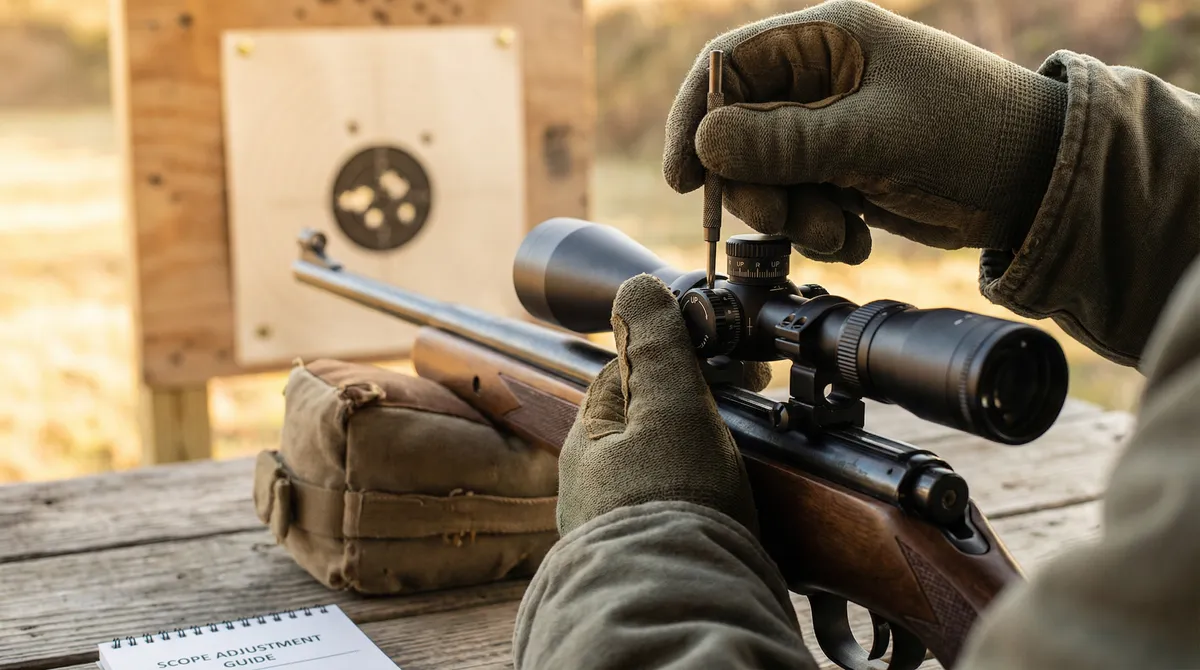
Screwdriver or Allen wrench for scope turret adjustments
-
Range finder or measured distance markers
-
Eye and ear protection
-
Notepad and pen for recording adjustments
Pro Tip: Pellet Selection Matters
Always sight in with the exact pellet you plan to use most often. Different pellet weights, head sizes, and designs will impact at different points. If you switch pellets later, expect to re-zero your scope. For hunting, sight in with your hunting pellet. For target shooting, use your competition pellet.
Understanding Scope Adjustments
Before you start adjusting, you need to understand how scope turrets work. Most air rifle scopes have two adjustment turrets:
-
Windage (horizontal): Usually on the right side of the scope—moves point of impact left or right
-
Elevation (vertical): Usually on top of the scope—moves point of impact up or down
MOA vs. MIL Adjustments
Most air rifle scopes use MOA (Minute of Angle) adjustments. One MOA equals approximately 1 inch at 100 yards, which translates to:
-
At 25 yards: 1 MOA = 1/4 inch
-
At 50 yards: 1 MOA = 1/2 inch
-
At 10 yards: 1 MOA = 1/10 inch
Most budget to mid-range scopes adjust in 1/4 MOA clicks. This means each click moves the point of impact 1/4 inch at 100 yards, or approximately 1/16 inch at 25 yards. Higher-end scopes may offer 1/8 MOA clicks for finer adjustments.
Which Way to Turn?
Here’s the critical rule that confuses many shooters learning how to sight in air rifle scopes:
Move your adjustments toward where you want the shots to go.
-
Shots hitting low? Turn elevation turret UP
-
Shots hitting high? Turn elevation turret DOWN
-
Shots hitting left? Turn windage turret RIGHT
-
Shots hitting right? Turn windage turret LEFT
Most scopes mark the turrets with arrows indicating the direction of point-of-impact shift. When in doubt, check your scope’s manual.
Step-by-Step: How to Sight In an Air Rifle
Follow these steps systematically to zero air rifle scope systems efficiently:
Step 1: Verify Secure Scope Mounting
Before firing a single shot, confirm your scope is properly mounted:
-
Check that all scope ring screws are properly torqued
-
Verify the scope rail or mount is secure to the rifle
-
Ensure the scope is level (use a bubble level if available)
-
Confirm proper eye relief (full sight picture without scope shadow)
A loose scope will never hold zero. This is the most common cause of unexplained accuracy problems, especially on magnum spring and gas piston air rifles that generate significant recoil.
Step 2: Bore Sight at Close Range (Optional but Recommended)
Bore sighting gets your scope roughly aligned before you start shooting, saving pellets and frustration:
-
Remove the barrel or open the action to see through the bore (if your rifle design allows)
-
Rest the rifle securely on sandbags
-
Look through the bore and center it on a target at 10-15 yards
-
Without moving the rifle, adjust your scope to aim at the same point
-
This gets you “on paper” without firing a shot
If you can’t bore sight (many break barrels won’t allow it), start at a very close range (10 yards) to ensure your first shots hit the target.
Step 3: Fire Your First Group at 10 Yards
Starting close ensures you’ll hit paper and establishes a baseline:
-
Set up a paper target at exactly 10 yards
-
Rest your rifle on a stable support (sandbags or shooting rest)
-
Aim at the center of your target
-
Fire 3-5 shots using consistent technique
-
Check where your group centered (ignore flyers from shooter error)
Important: Use Proper Technique
For spring and gas piston air rifles, use the artillery hold technique when sighting in. Inconsistent hold will produce inconsistent groups, making it impossible to properly zero your scope. PCP and CO2 rifles are less hold-sensitive but still benefit from consistent shooting form.
Step 4: Make Initial Windage and Elevation Adjustments
Based on your 10-yard group, make your first adjustments:
-
Measure how far your group center is from your aim point (in inches)
-
Calculate the needed adjustment based on your scope’s click value
-
For a typical 1/4 MOA scope at 10 yards: 1 inch of correction requires approximately 40 clicks
-
Make windage and elevation adjustments separately for clarity
-
Record your adjustments in your notepad
Example: Your group is hitting 1 inch low and 1/2 inch right at 10 yards. You need approximately 40 clicks UP on elevation and 20 clicks LEFT on windage.
Step 5: Confirm at 10 Yards
After adjustments, fire another 3-5 shot group:
-
Use a fresh target or aim point
-
Fire your confirmation group
-
Check results—you should be much closer to center
-
Make fine-tuning adjustments if needed
-
Repeat until you’re hitting within 1/4 inch of your aim point
Step 6: Move to Your Primary Zero Distance
Once zeroed at 10 yards, move to your intended zero distance:
-
Set up a fresh target at your chosen distance (typically 25-35 yards)
-
Fire a 3-5 shot group
-
Measure the group center’s offset from your aim point
-
Calculate and apply necessary adjustments
-
Fire confirmation groups until zeroed
Step 7: Final Verification
Once you believe you’re zeroed, confirm with a final test:
-
Fire 5-10 shots at your zero distance
-
Verify the group centers on your aim point
-
Note your final turret positions (many shooters mark them)
-
Test at one or two other distances to understand your trajectory
Recommended Zero Distances by Use
Choosing the right zero distance depends on how you’ll use your air rifle:
| Primary Use | Recommended Zero | Reasoning |
|---|---|---|
| Backyard Plinking | 20-25 yards | Common shooting distances in most backyards |
| Pest Control | 25-30 yards | Typical engagement range, minimal holdover needed inside 40 yards |
| Small Game Hunting | 30-35 yards | Balances point-blank range with extended distance capability |
| Field Target Competition | 25-30 yards | Middle of typical competition distances (10-55 yards) |
| Long-Range Shooting | 40-50 yards | Minimizes holdover at extended distances |
For most airgunners, a 30-yard zero provides the best all-around versatility. You’ll shoot slightly high at close range and need modest holdover at 40+ yards, but you’ll be accurate without adjustment across the most common shooting distances.
When to Adjust Your Scope vs. Use Holdover
Once you’ve learned how to sight in air rifle optics, you’ll face an ongoing question: should you adjust your scope for different distances or use holdover?
When to Adjust Your Scope
-
You’re shooting at a single known distance (target practice, competition)
-
You have time to set up and make precise shots
-
Maximum accuracy is required (small targets, long range)
-
Your scope has reliable, repeatable adjustments
When to Use Holdover
-
You’re hunting and distances vary
-
Quick shots are needed (pest control, reactive shooting)
-
Distance differences are moderate (within 10-15 yards of your zero)
-
Your scope has a mil-dot or holdover reticle
Most hunters prefer learning their rifle’s trajectory and using holdover rather than adjusting turrets in the field. Target shooters often dial exact adjustments for each distance. Neither approach is wrong—it depends on your application.
Common Mistakes When Zeroing an Air Rifle
Avoid these frequent errors that frustrate shooters trying to sight in pellet gun scopes:
Mistake #1: Adjusting After Every Shot
Single shots don’t tell you where your rifle is actually shooting. Always fire 3-5 shot groups before making adjustments. Use the group center, not individual shots, to determine needed corrections.
Mistake #2: Inconsistent Shooting Position
If your hold, position, or rest changes between shots, your groups will scatter regardless of how well your scope is zeroed. Establish a stable, repeatable shooting position before attempting to zero.
Mistake #3: Using Unsuitable Pellets
Low-quality or damaged pellets won’t group consistently no matter how good your rifle and scope are. Use quality, undamaged pellets sorted by head size if you’re serious about accuracy.
Mistake #4: Loose or Improper Scope Mounting
This is the most common cause of zero shift. Ensure your scope is mounted in quality rings, properly torqued, and—for spring/gas piston rifles—using airgun-rated rings and mounts with a scope stop.
Mistake #5: Ignoring Environmental Conditions
Wind, temperature, and lighting affect shooting. Zero your rifle in calm conditions and understand that extreme cold or heat may shift your zero slightly.
Mistake #6: Not Allowing Barrel Break-In
New barrels, especially on quality rifles, often need 100-500 shots before they stabilize and shoot their best. Don’t obsess over zeroing a brand-new rifle—get some rounds through it first, then fine-tune your zero.
Mistake #7: Wrong Distance Estimation
If you think you’re shooting at 30 yards but you’re actually at 25 or 35, your zero will be off. Use a rangefinder or measure your distances precisely, especially when first zeroing.
Maintaining Your Zero
Once zeroed, your scope should hold its setting—but several factors can cause zero shift:
-
Scope ring/mount screws loosening (check periodically)
-
Scope internal damage (from recoil or impact)
-
Temperature changes (significant shifts affect some scopes)
-
Changing pellet brands or weights
-
Stock warping (wooden stocks in humid environments)
-
Spring fatigue (velocity loss in spring rifles over thousands of shots)
Periodically verify your zero, especially before hunting season or competition. A quick 3-shot group at your zero distance confirms everything is still aligned.
Related Guides on PelletGuns101
Looking to improve your air rifle accuracy? Check out these related guides:
-
Best Air Rifle Scopes Guide
-
Mastering the Artillery Hold
-
10 Tips for Better Air Rifle Accuracy
Final Thoughts
Learning how to sight in an air rifle properly is a fundamental skill that pays dividends every time you shoot. By following a systematic approach—starting close, making measured adjustments, and verifying your zero—you’ll spend less time chasing your point of impact and more time enjoying accurate shooting.
Remember these key points:
Quick Summary: Sighting In Your Air Rifle
-
Start close (10 yards) to get on paper
-
Shoot groups (3-5 shots) before adjusting
-
Adjust toward where you want shots to go
-
Move to final zero distance once close at 10 yards
-
Verify with a final 5-10 shot group
-
Use consistent technique throughout the process
-
Record your settings for future reference
Whether you’re preparing for hunting season, getting ready for competition, or just want to ring steel in the backyard, a properly zeroed scope is the foundation of accurate shooting. Take the time to do it right, and you’ll be rewarded with consistent, confidence-inspiring accuracy.
Happy shooting!
Disclosure: PelletGuns101.com is a participant in the Amazon Services LLC Associates Program, an affiliate advertising program designed to provide a means for sites to earn advertising fees by advertising and linking to Amazon.com. When you purchase through our links, we may earn a small commission at no additional cost to you. This helps support our site and allows us to continue providing free airgun content and reviews.