Last updated: November 2026
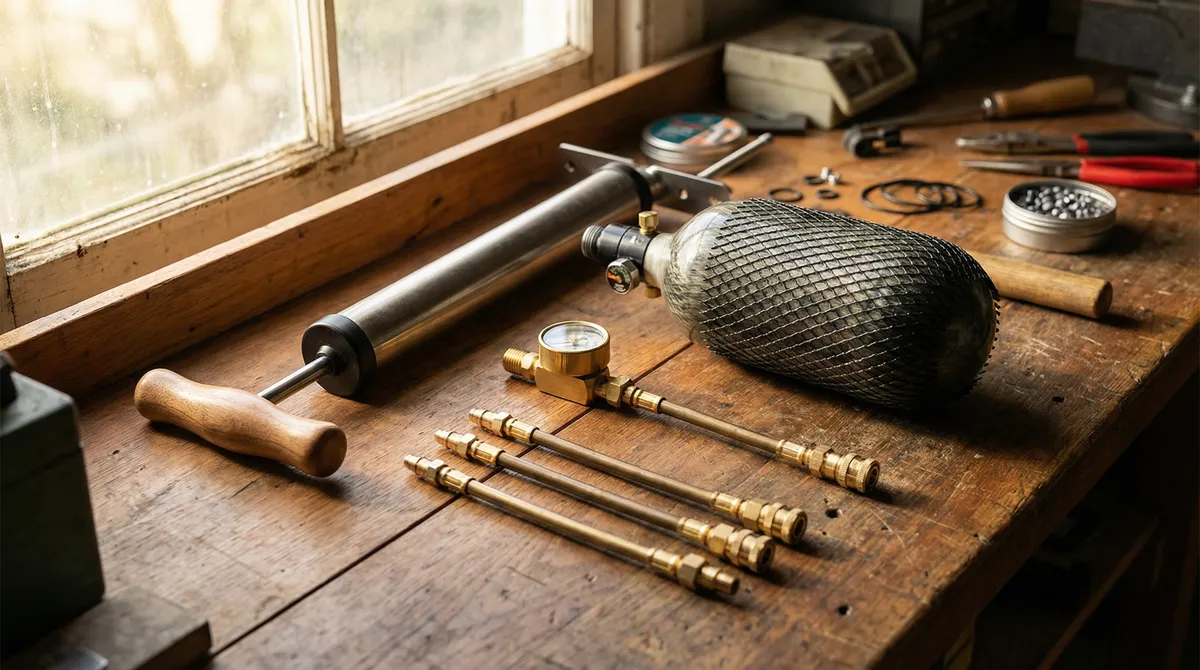
You’ve invested in a quality PCP air rifle—now you need the right accessories to actually shoot it. Unlike spring-powered guns that work right out of the box, PCP airguns require fill equipment, and choosing the wrong setup can cost you hundreds of dollars in mistakes. This comprehensive guide covers everything you need to know about PCP air rifle accessories, from budget hand pumps to professional-grade compressors.
Understanding PCP Fill Equipment: The Foundation
Pre-charged pneumatic (PCP) air rifles operate on compressed air stored in an onboard reservoir, typically at pressures between 2,000 and 4,500 PSI. That air has to come from somewhere, and your choice of fill equipment will significantly impact your shooting experience, long-term costs, and convenience. If you’re new to PCP shooting, our PCP vs Spring Air Rifle comparison explains why many shooters make the switch.
There are three primary methods for filling PCP air rifles:
-
Hand pumps – Manual labor, lowest cost, unlimited fills
-
Carbon fiber tanks – Portable, fast fills, requires tank refills
-
Electric compressors – Highest convenience, highest initial cost
Each method has distinct advantages depending on your shooting volume, budget, and access to resources. Let’s break down the economics and practical considerations for each option.
Hand Pumps: The Entry Point for PCP Air Rifle Accessories
Hand pumps represent the most affordable entry into PCP shooting, but they come with a significant trade-off: physical effort. A quality hand pump like the Air Venturi MK5 can fill rifles up to 4,500 PSI, but you’ll earn every shot with your own labor.
What to Expect from Hand Pumping
Most shooters find this manageable for a single fill session, but it becomes tedious if you’re shooting multiple magazines at the range.
The Air Venturi MK5 has become the go-to recommendation because of its efficient three-stage design, built-in moisture filter, and durable construction. Cheaper pumps exist, but they often fail prematurely or require excessive effort to reach higher pressures.
Air Venturi MK5 Hand Pump
Price: ~$200
Max Pressure: 4,500 PSI
Stages: 3-stage design
Best For: Occasional shooters, backup fill option, budget-conscious buyers
Hand Pump Pros and Cons
Advantages:
-
Lowest initial investment (~$150-250)
-
Completely self-sufficient—no refills needed
-
Portable for field use
-
No ongoing costs after purchase
-
Excellent backup option even if you have other equipment
Disadvantages:
-
Physical effort required (can be exhausting for large reservoirs)
-
Slow fill times (5-15 minutes per fill)
-
Impractical for high-volume shooting
-
Generates heat and moisture that must be managed
Carbon Fiber Tanks: The Most Popular PCP Air Rifle Accessory
For most serious PCP shooters, a carbon fiber tank represents the ideal balance between cost and convenience. These tanks store compressed air at 4,500 PSI and can fill your rifle dozens of times before needing to be refilled themselves. Popular PCPs like the budget-friendly options under $400 work perfectly with this setup.
The Ninja Carbon Fiber 68ci Tank has become an industry standard, originally designed for paintball but perfectly suited for PCP airgun use. Its lightweight construction and proven durability make it the most popular choice among airgun enthusiasts.
How Carbon Fiber Tanks Work for Airguns
Larger reservoir rifles like big bores will get fewer fills, while smaller rifles with efficient designs might get 25+ fills per tank.
To use a carbon fiber tank, you’ll need a fill whip that connects the tank to your rifle, plus a pressure regulator (usually built into the tank valve) to control air flow. The fill process takes just 30-60 seconds—connect, open the valve slowly, watch the gauge, close when full.
Ninja Carbon Fiber Tank 68ci 4500 PSI
Price: ~$250
Capacity: 68 cubic inches at 4,500 PSI
Weight: ~2.5 lbs empty
Best For: Regular shooters, range use, those with access to air fills
Where to Get Tanks Filled
This is the critical question for tank ownership. Common options include:
-
Paintball shops – Most common option, typically $5-10 per fill
-
Scuba dive shops – Can fill to high pressures, $5-15 per fill
-
Fire departments – Some will fill tanks for free or small donations
-
Airgun specialty dealers – Best option if available locally
Before buying a tank, verify you have accessible fill options. Call local paintball shops and dive shops to confirm they can fill to 4,500 PSI—some only fill to 3,000 PSI, which reduces your fills-per-tank significantly.
Electric Compressors: Complete Independence
For shooters who want total self-sufficiency without the physical labor of hand pumping, an electric compressor is the ultimate PCP air rifle accessory. Modern portable compressors designed specifically for airguns have become remarkably affordable, with quality units available under $1,000. This is especially valuable for high-volume shooters or those with multiple rifles like the Benjamin Marauder or Air Venturi Avenger.
The Air Venturi Nomad II Compressor represents the current sweet spot in the market—powerful enough for serious use, portable enough for transport, and priced accessibly for hobbyist shooters.
Air Venturi Nomad II Compressor
Price: ~$700
Max Pressure: 4,500 PSI
Power: 110V AC or 12V DC
Features: Auto-shutoff, moisture separator, fan-cooled
Best For: Frequent shooters, those without tank fill access, maximum convenience
Compressor Economics: When Does It Make Sense?
Let’s run the numbers. If you’re paying $8 per tank fill at a paintball shop and shooting regularly:
-
Monthly cost (2 fills/week): ~$64/month, $768/year
-
Nomad II payback period: Under 1 year
-
Electricity cost per fill: Approximately $0.05-0.10
For frequent shooters, a compressor pays for itself within a year. Even for moderate shooters filling once a week, the break-even point is around 18-24 months. Factor in the convenience of filling anytime without leaving home, and the value proposition becomes compelling.
Compressor Considerations
Not all compressors are created equal. Key factors to evaluate:
-
Fill time – Better compressors fill a rifle in 3-5 minutes, cheaper ones may take 15-20
-
Duty cycle – How long can it run before needing to cool down?
-
Moisture management – Quality units have built-in water separators
-
Auto-shutoff – Prevents overfilling and damage
-
Noise level – Important for home use
Essential Supporting Accessories: Fill Whips and Quick Disconnects
Beyond the primary fill equipment, several supporting accessories are essential for a functional PCP setup. Understanding these components prevents compatibility issues and ensures safe operation.
Fill Whips Explained
A fill whip is a high-pressure hose that connects your air source (tank or compressor) to your rifle’s fill port. Quality fill whips feature:
-
Braided stainless steel construction rated for 6,000+ PSI
-
Flexible length (typically 36-48 inches)
-
Appropriate fittings on both ends
-
Bleed valve for safe disconnection
PCP Fill Whip with Gauge
Price: ~$40-60
Features: 4,500 PSI rated, stainless braided, bleed valve included
Foster vs DIN Quick Disconnects: The Critical Distinction
This is where many new PCP shooters get confused—and potentially make expensive mistakes. There are two primary quick-disconnect standards in the airgun world:
Foster Fitting (American Standard)
-
Most common on American-made airguns
-
Used by Air Venturi, Crosman/Benjamin, and many others
-
Standard paintball tank connection
-
Quick-release design—push the collar to disconnect
DIN Fitting (European Standard)
-
Common on European airguns (FX, Daystate, Weihrauch, etc.)
-
Threaded connection—screws on/off
-
Often considered more secure for higher pressures
-
Requires adapters to work with Foster equipment
Before purchasing any fill equipment, verify what fitting your rifle uses. Check your rifle’s manual or look at the fill port—Foster fittings have a smooth bore with ball bearings visible, while DIN ports have internal threads.
Foster/DIN Adapter Kit
Price: ~$25-40
Includes: Male/female adapters for both standards
Moisture Traps and Filters: Protecting Your Investment
Compressed air contains moisture, and moisture inside your PCP rifle causes corrosion, seal degradation, and accuracy problems. Proper moisture management is one of the most overlooked aspects of PCP air rifle accessories.
Why Moisture Is the Enemy
When air is compressed, water vapor condenses. A hand pump at full exertion or a compressor working hard generates significant heat, which means more moisture. Without proper filtration, this wet air enters your rifle’s reservoir, where it can:
-
Corrode internal metal components
-
Degrade O-rings and seals
-
Cause inconsistent valve operation
-
In cold weather, freeze and block air passages
Types of Moisture Management
Inline Moisture Traps – These attach between your fill source and rifle, using desiccant material or mechanical separation to remove water. They require periodic maintenance (draining or desiccant replacement) but provide excellent protection.
Water Separators – Built into many compressors and some hand pumps, these use centrifugal force or cooling to condense and drain water before it reaches your fill whip.
Desiccant Filters – Cartridges filled with moisture-absorbing material. The color-changing varieties show when the desiccant is saturated and needs replacement or regeneration.
PCP Moisture Trap with Desiccant Filter
Price: ~$30-50
Features: Inline installation, color-indicating desiccant, 4500 PSI rated
Complete PCP Accessories Comparison Table
| Product | Price | Max PSI | Best For | Link |
|---|---|---|---|---|
| Air Venturi MK5 Hand Pump | ~$200 | 4,500 | Budget entry, backup | View |
| Ninja CF Tank 68ci | ~$250 | 4,500 | Regular shooters | View |
| Air Venturi Nomad II | ~$700 | 4,500 | Frequent shooters | View |
| Fill Whip with Gauge | ~$50 | 4,500 | All setups | View |
| Quick Disconnect Adapter Kit | ~$35 | 4,500 | Multi-rifle owners | View |
| Moisture Trap/Filter | ~$40 | 4,500 | All setups | View |
Budget-Specific Setup Recommendations
Let’s put together complete PCP air rifle accessory packages at three budget levels:
$200 Budget: The Starter Setup
-
Air Venturi MK5 Hand Pump (~$200)
-
Built-in moisture filter (included with pump)
-
Total: ~$200
Best for: New PCP owners, occasional shooters, budget-conscious buyers who don’t mind the workout.
$500 Budget: The Popular Choice
-
Ninja Carbon Fiber Tank 68ci (~$250)
-
Fill whip with gauge (~$50)
-
Quick disconnect adapters (~$35)
-
Moisture trap/filter (~$40)
-
Air Venturi MK5 Hand Pump as backup (~$200)
-
Total: ~$575
Best for: Regular shooters with access to tank fills, those wanting quick fills with manual backup.
$1,000 Budget: The Complete Setup
-
Air Venturi Nomad II Compressor (~$700)
-
Ninja Carbon Fiber Tank 68ci (~$250) – for portable/field use
-
Fill whip with gauge (~$50)
-
Quick disconnect adapter kit (~$35)
-
Additional moisture filter (~$40)
-
Total: ~$1,075
Best for: Frequent shooters, those without tank fill access, shooters wanting maximum convenience and self-sufficiency.
Safety Essentials: Non-Negotiable Practices
Working with compressed air at 3,000-4,500 PSI demands respect. These safety practices are non-negotiable:
Critical Safety Rules
-
Never exceed your rifle’s rated fill pressure. Overfilling can cause catastrophic failure. If your rifle is rated for 3,000 PSI, stop at 3,000 PSI—not 3,100, not “just a little more.”
-
Always open fill valves slowly. Rapid pressure changes generate heat and can damage seals or cause equipment failure.
-
Bleed pressure before disconnecting. Always release residual pressure from fill whips before removing connections.
-
Inspect O-rings regularly. Damaged seals can cause sudden pressure release. Replace any O-ring showing wear, cracking, or deformation.
-
Never point fill equipment at anyone. A failed fitting at 4,500 PSI becomes a dangerous projectile.
-
**
Connection Best Practices
When connecting fill equipment:
-
Ensure all connections are clean and free of debris
-
Thread connections carefully—cross-threading damages fittings
-
Hand-tighten only unless instructions specify otherwise
-
Listen and feel for air leaks before pressurizing fully
-
Apply appropriate lubricant to O-rings (silicone-based, never petroleum)
Fill Equipment Maintenance
Proper maintenance extends equipment life and ensures safe operation:
Hand Pump Maintenance
-
Clean and lubricate piston seals every 500-1,000 strokes
-
Inspect check valves annually
-
Replace moisture filter media when saturated
-
Store in dry location out of direct sunlight
Carbon Fiber Tank Maintenance
-
Never drop or subject to impact
-
Avoid exposure to chemicals, solvents, or petroleum products
-
Store at partial pressure (1,000-2,000 PSI) rather than empty or full
-
Check O-rings on fill valve before each use
-
Comply with hydrostatic testing requirements
Compressor Maintenance
-
Drain water separator after each use
-
Replace filter elements according to manufacturer schedule
-
Allow adequate cooling time between extended fills
-
Keep air intakes clean and unobstructed
-
Check oil level (if applicable) regularly
The Upgrade Path: Planning for Growth
Your PCP air rifle accessories needs will evolve. Here’s a smart upgrade path:
Stage 1: Getting Started
Start with a hand pump. This teaches you the fundamentals of PCP operation, fill procedures, and pressure management. Even if you plan to upgrade, keep the pump—it’s invaluable as a backup and for field use.
Stage 2: Adding Convenience
Once you’ve confirmed PCP shooting is for you, add a carbon fiber tank. This dramatically speeds up your range sessions while keeping costs reasonable. Your hand pump becomes your backup.
Stage 3: Complete Independence
When shooting volume justifies it, invest in a compressor. Now you can fill your rifle and your tank at home, anytime. The tank becomes your portable option for range days and field use.
Stage 4: Multiple Rifles
As your collection grows, invest in a quality adapter kit with multiple fittings. This allows one fill setup to service rifles with different fill ports. Consider a larger tank (88-90ci) for extended sessions.
Frequently Asked Questions
Q: Can I use a SCUBA tank to fill my PCP rifle?
Yes, with the right adapter. SCUBA tanks typically fill to 3,000 PSI, which works for many PCP rifles. You’ll need a SCUBA-to-airgun fill adapter. However, carbon fiber tanks designed for airgun use are generally more convenient due to their higher pressure (4,500 PSI) and lighter weight.
Q: How do I know when to stop filling?
Use a fill whip with an integrated gauge, or monitor your rifle’s onboard gauge if equipped. Stop when you reach the rifle manufacturer’s recommended fill pressure—never exceed it. Many compressors feature auto-shutoff that can be set to your rifle’s specific pressure.
Q: My rifle has a built-in gauge. Do I need a separate gauge?
A fill whip with its own gauge provides redundancy and is generally more accurate than small onboard gauges. It’s also easier to read during the fill process. Consider the onboard gauge a backup reference.
Q: How long does a compressor take to fill a rifle?
Most quality compressors fill a typical PCP rifle (200-300cc reservoir) from 2,000 to 3,000 PSI in 2-5 minutes. Filling from empty takes longer—approximately 5-10 minutes for most setups. Budget compressors may take 15-20 minutes.
Q: Do I really need a moisture trap if my pump/compressor has one built in?
For compressors with quality built-in separation systems, an additional inline filter is optional but provides extra protection. For hand pumps, an additional moisture trap is highly recommended, especially in humid climates or during intensive pumping sessions.
Final Thoughts
Investing in quality PCP air rifle accessories is essential for enjoying your airgun to its fullest potential. While the initial investment can seem substantial, proper fill equipment pays dividends in convenience, shooting enjoyment, and rifle longevity. Combined with proper maintenance practices and quality pellets, you’ll get the most from your PCP investment.
For most shooters, we recommend starting with a quality hand pump to learn the fundamentals, then adding a carbon fiber tank when convenience becomes a priority. Serious shooters who put hundreds or thousands of pellets downrange annually will find a compressor pays for itself quickly while providing unmatched convenience.
Whatever your budget, prioritize quality over price. A reliable $200 hand pump outperforms a $75 pump that fails after six months. A $250 carbon fiber tank from a reputable manufacturer is safer and more durable than an unknown import.
Your fill equipment is the foundation of your PCP shooting experience—invest wisely, maintain diligently, and shoot safely. Ready to choose your first PCP? Check out our Avenger vs Gauntlet 2 comparison or browse our best backyard air rifles guide.
Ready to Complete Your PCP Setup?
Browse our recommended fill equipment and accessories on Amazon:
Shop PCP Accessories on Amazon
Disclosure: PelletGuns101.com is a participant in the Amazon Services LLC Associates Program. We earn commissions from qualifying purchases made through links on this page at no additional cost to you. We only recommend products we believe provide value to our readers.