As an Amazon Associate, we earn from qualifying purchases. Buying through our links costs you nothing extra. Prices and availability are accurate as of the publication date.
Most air rifles die of neglect long before they wear out. A seal dries up because nobody put a drop of oil where the manual said to. A barrel gets scrubbed with a steel rod from a centerfire kit and the crown never recovers. A PCP sits empty in the safe because the fill gear costs more than the owner expected.
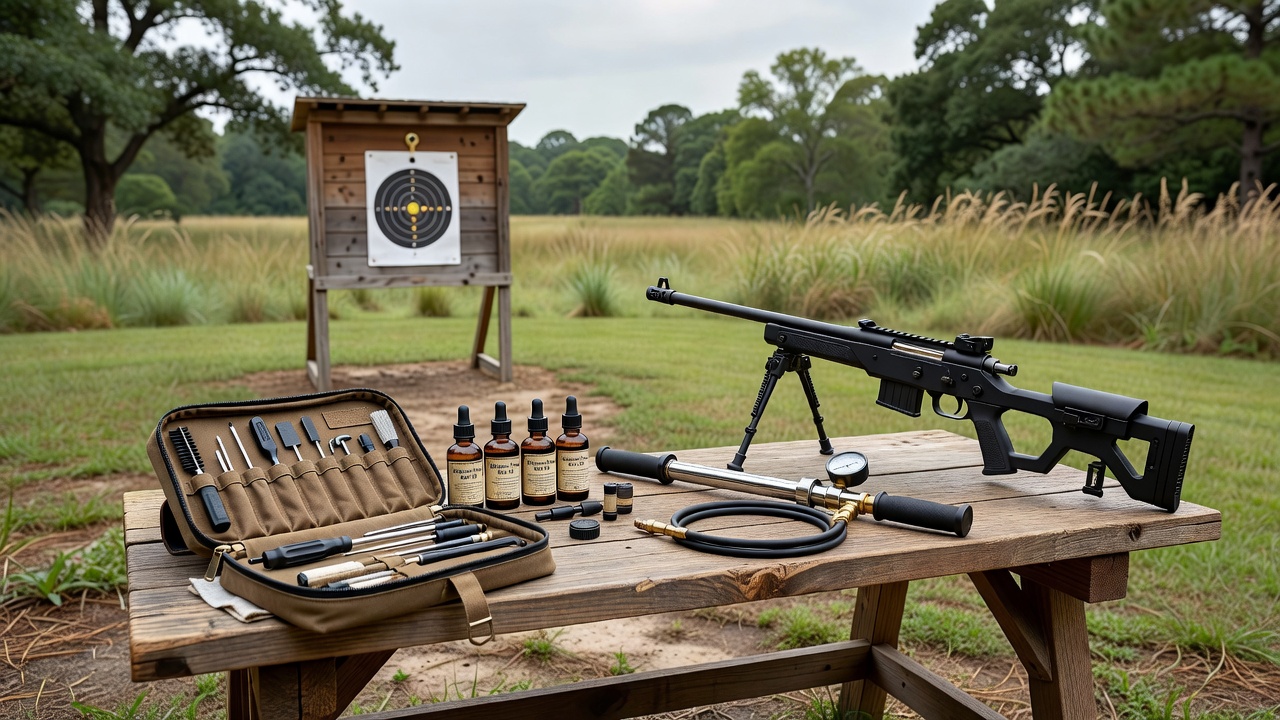
None of that is complicated to avoid. It’s just three separate jobs that get lumped under one word: cleaning the bore, oiling the right parts with the right stuff, and — if you shoot PCP — getting air into the gun. This guide walks each one, then goes through the gear on this page so you can tell what a kit actually contains before you spend money on it.
One warning up front, because it’s the one that costs the most: the oil that’s correct for one airgun can wreck another. Read the powerplant section before you buy a bottle.
How dirty does an air rifle barrel actually get?
Less than a firearm, and that surprises people. There’s no burning powder, no copper jacket, no carbon fouling in the usual sense. What you get instead is lead — soft pellet lead smearing into the rifling — plus whatever oil and dust has migrated down the bore between sessions.
That means the schedule is loose. Clean when groups open up and you’ve ruled out the shooter, the pellet, and the scope mounts. Clean after a season in a damp shed. Clean a used gun you just brought home, because you have no idea what’s in it. Beyond that, scrubbing a bore that’s shooting well is a good way to make it shoot worse for the next fifty pellets while it re-seasons.
The risk isn’t dirt. It’s the tool. Airgun rifling is shallow compared to a centerfire barrel — Gamo makes exactly this point about its own kit, saying its components are designed to eliminate the possibility of damage to the relatively shallow rifling of airguns. A steel rod dragged across it, or a hard jag banged into the crown at the muzzle, does damage that no amount of cleaning undoes.
Rod or flex cable — which one you want
There are two ways to get a patch down a barrel, and the kits on this page split roughly along that line.
A sectional rod screws together from several pieces into one stiff shaft. You get push, which matters for a stubborn lead smear, and you get a jag that holds a patch tight against the rifling. The catch is that a rod is only as safe as your hands — a stiff rod plus a hard barrel equals contact you can’t take back.
A nylon-coated flex cable is the other approach. You drop the weighted end through the breech, pull the brush or patch through toward the muzzle, and the coating keeps metal off metal. Several of these kits sell that coating as the point; one describes it as ensuring zero metal-to-metal contact with the barrel’s interior. Pulling also means you’re working with the direction of the rifling and you’re not shoving anything into the crown.
Most buyers want the cable for routine work and the rod for the occasional problem. Several kits here include both, which is why they’re worth more than the cheapest option.
Match the oil to your powerplant — this is the one that breaks guns
Airguns are not one category. A CO2 pistol, a multi-pump pneumatic, a spring-piston break barrel, and a PCP have almost nothing mechanically in common, and the lubricant that keeps one alive can destroy another.
Here’s the short version. CO2 and pump pneumatics live on their seals, and those seals dry out. Crosman says its Pellgunoil conditions those seals and keeps them pliable so they do not crack, shrink, or fail from lack of lubrication — a drop on the tip of a fresh CO2 cartridge before you seat it is the classic application. Crosman is also explicit about where it does not go: the label says NOT for use with Break Barrel and PCP Air rifles.
That exclusion is the whole ballgame for spring-piston guns. A springer’s compression chamber gets hot enough under compression to ignite the wrong oil — the loud crack people call dieseling. Petroleum oil in a spring gun chamber is how you get a detonation that can break the gun. Spring guns take a small amount of silicone chamber oil, if anything at all, and only where the manual tells you.
PCPs are the opposite problem: they want almost nothing. The internals are lubricated at the factory, and the maintenance that matters is filling with dry air, not oiling. Anything you put in a PCP’s air path is going somewhere you can’t reach.
So before you buy a bottle, answer one question: what powers your rifle? If you can’t answer it, the manual can, and the manual outranks anything on this page.
What a general-purpose gun oil is and isn’t for
Several products here are firearm oils rather than airgun oils. That’s not a knock — they’re good at what they do, and what they do is the outside of the gun.
External metal rusts. A barrel that lives in a humid barn, a rifle that got rained on during a walk-around, a gun going into storage for the winter — that’s where a rust preventive earns its keep. Lucas says its gun oil can be applied heavily for rust proofing during long term storage or applied lightly for immediate use, which is the right framing for how you’d actually use it.
What these oils are not is a chamber lubricant for a spring gun or something to introduce into a pneumatic’s air system. Wipe the outside, keep it off the bore, and don’t let it migrate into the powerplant.
The PCP air problem, priced honestly
A PCP is a rifle with an empty air tank attached. The rifle is the smaller purchase. Getting 3,000-plus PSI of clean, dry air into it, repeatedly, forever, is the real commitment — and it’s why so many PCPs get sold barely used.
A hand pump is the cheapest way in and the most work. It’s a multi-stage piston pump you stand on and lever down, and the numbers on this page tell you what you’re signing up for. GX quotes real fill counts for its pump: filling a 500cc tank from 1000psi to 3000psi needs 420 fills, and a 200cc tank over the same span needs 180 fills. That’s per fill of the tank, not per shooting session — but it’s honest arithmetic about how much of your afternoon a pump costs.
Three things separate a decent pump from a bad one. Stages: more compression stages means less effort per stroke at high pressure, which is why nearly everything here is three- or four-stage. Moisture handling: compressing atmospheric air condenses water out of it, and water in a PCP’s valve is corrosion you can’t see until it leaks. Several of these pumps carry a built-in oil-moisture filter, and VEVOR claims its four-stage filter removes over 90% of water content. Gauge: you need to see pressure while you pump so you stop where your rifle’s manufacturer says to, not where the pump tops out.
And one habit, stated plainly because it protects both you and the gear: bleed the pressure out before you disconnect, and store the pump unpressurized. One manufacturer spells it out — open the bleed valve after filling to release trapped pressure from the hose before removing the quick connector. Another says the same thing about storage: when not in use, leave the PCP pump as unpressurized as possible.
Reading a cleaning kit listing without getting fooled
Cleaning kits are a category where listings all use the same words and the products aren’t the same. Four things separate them.
What’s in the box. Count the actual accessories per caliber, not the headline number. A kit that advertises pieces may be counting fifty individual patches toward its total. Look for a brush, a mop, and a jag in your caliber specifically.
Brush material. Nylon is gentler; bronze cuts lead better. Some kits give you both per caliber, some give you nylon only. Neither is wrong — but know which one you bought.
Rod reach. A rod that won’t reach the muzzle from the breech is a rod that can’t finish the job. CVLIFE ships six rods that combine to 30 inches; the Magsaddle-branded kit assembles to a 29.4-inch rod; XXLIYA’s three brass rods total 28.32 inches. Longer barrels want the longer assembly.
Caliber honesty. Nearly every listing here says .177 and .22 and then writes it three different ways — .17 cal, .177, 4.5mm — inside the same bullet list. That’s sloppy copywriting, not necessarily a bad kit, but it means you verify your own caliber before ordering rather than trusting the title. If a listing genuinely can’t tell you what caliber the brushes are, skip it.
Air Rifle Maintenance Guide
1. Motanar 177 Cal & .22 Cal Airgun Cleaning Kit
The distinguishing item here is the pair of stainless steel picks — the kind of thing you don’t miss until you’re trying to dig hardened gunk out of a breech face or a transfer port. Motanar lists them for cleaning stubborn areas, and that’s a job the brushes and mops in every other kit on this page simply can’t do.
Otherwise it’s a well-stocked dual-caliber set: nylon brush, cotton mop, brass brush, brass jag and slotted tip in both .22 and .177, plus a 31.5-inch nylon coated cleaning cable for pull-through work. The rod system is one 8-32 threaded rod for the T-handle and four 5-40 rods for the accessories, so you get both approaches in one case.
What you don’t get is a stated case size, so if you’re buying for a specific range bag pocket, that’s an unknown going in.
Best for: Someone who wants both caliber’s brushes plus picks for the crud a brush won’t reach
Listed at $13.99 when this guide was last updated. Amazon pricing moves, so check the figure on the page before you buy.
2. Raiseek .177 Cal & .22 Cal Airgun Cleaning Kit with Cotton Mop Brass Cleaning Rod Nylon Brushes in Zippered Organizer Compact Case
Sixteen pieces in a zippered case that Raiseek sizes at 6.5” x 3.5” x 2” — small enough to know it’ll fit before you order, which is more than most listings tell you. The rod setup matches the pattern: one 8-32 rod for the T-handle, four 5-40 rods for brushes, mops, jags, and the patch holder, plus a 31.5-inch nylon coated flex cable.
Raiseek addresses the failure mode that kills cheap kits directly, saying it moved to an upgraded metal rod material specifically so the rod doesn’t snap. A broken rod section in a barrel is a bad afternoon, so that’s a claim worth the couple of extra dollars if it holds.
Read the accessory list carefully against the sibling Raiseek kit below — this one’s the rod-plus-cable version, the other is cable-only.
Best for: A rod-and-cable kit where you know the case dimensions before it arrives
Listed at $19.99 when this guide was last updated. Amazon pricing moves, so check the figure on the page before you buy.
3. CVLIFE Gun Cleaning Kit for 177, .22 Caliber, 17hmr for Airgun, Rifle
The reach champion of the cheap kits. CVLIFE includes six brass rods rather than the usual five, and says the full assembly gives 30 inches — enough for the longest barrels in these calibers. If you shoot a long-barreled springer or a full-length PCP, that extra section is the difference between finishing the stroke and stopping short.
The rods themselves are the other pitch: a 24% thicker tube wall than the previous design, aimed at the bending that plagues thin brass. Bore brushes are nylon, described as stiff and densely packed to lift lead and carbon without damaging the rifling. You also get 50 cleaning patches, so you’re not immediately shopping for consumables.
Case is 6.7 x 4.53 inches. Note that CVLIFE pitches this at .223 and 5.56 as well as the airgun calibers — the brushes you care about are the .177 and .22 ones.
Best for: Long barrels, where the extra rod section actually matters
Listed at $18.99 when this guide was last updated. Amazon pricing moves, so check the figure on the page before you buy.
4. .177 & .22 Cal Cleaning Kit for Airgun Pellet Gun BB Gun, 4.5/5.5mm Cleaning kit with Cotton Mop, Bronze and Nylon Brush, Brass Jag, Slotted Tips, Flex Cable, Brass Cleaning Rod in Compact Case
This is the most complete brush set on the page: nylon bore brush, bronze bore brush, and cotton mop for each caliber. That matters because nylon and bronze do different jobs — nylon for routine passes, bronze when there’s real lead to cut — and most kits here make you pick one.
Six connectable brass rods assemble to 29.4 inches, and the nylon-coated flex cable is 33 inches, the longest on this page. The maker’s framing of the cable is worth quoting because it’s the right reason to use one: the coating ensures zero metal-to-metal contact with the barrel’s interior, and pulling from breech to muzzle protects the crown. Twenty-plus pieces total in a zippered case of roughly 6.7” x 4.5”.
The catch is availability. This one isn’t showing as ready to ship, so treat it as a watch-list item rather than a buy-today.
Best for: The most thorough brush selection — bronze and nylon in both calibers
Listed at $17.99 when this guide was last updated. Amazon pricing moves, so check the figure on the page before you buy. Amazon lists this one for pre-order rather than immediate shipping.
5. XXLIYA 177 22 Caliber Gun Cleaning Kits for .22 Pellets Airsoft Gun Handgun 4.5/5.5mm Rifle Cleaning Rod Bore Brush Patches Cloth Supplies Firearms Pistol Hunting Shooting Accessories Maintenance
The stripped-down option. Three detachable brass rods totaling 720mm — that’s 28.32 inches — a cotton mop, a bronze brush, a brass holder, an adapter, and patches. No flex cable, no second brush type, no fitted case.
What it does have is thread flexibility, which is genuinely useful if you already own accessories. The rods are 5-40 and the kit includes an 8-32 adapter, so it’ll take either thread standard. If you’ve got a jag or brush from another kit sitting in a drawer, odds are it screws onto this.
XXLIYA is also the only listing here that tells you to check your firearm’s caliber before use, which is the correct instruction and one the fancier listings bury.
Best for: A basic rod set that accepts both common accessory thread sizes
Listed at $11.99 when this guide was last updated. Amazon pricing moves, so check the figure on the page before you buy.
6. Souso Cleaning Kit.177 pellets.177/.22 4.5mm/5.5mm Air Rifle Pistol Airgun Barrel Cleaning Brush Kit
The thinnest listing on the page, and you should read that as information. Souso tells you the kit covers .177 and .22, that it’s copper, that it’s light and portable, and that it won’t scratch the gun’s surface. It does not tell you how many rods, how long they are, which brushes are included, or what threads they use.
The copy also contains the line “we will improve the quality of the brushes” — which is a manufacturer telling you, in the present tense, that the brushes aren’t there yet.
It’s the cheapest way to own a rod and a brush, and for a plinker you keep in the truck that may be all you want. Just don’t buy it expecting to know what’s in the box before it shows up.
Best for: A bare-minimum rod and brush where you’re not fussy about the details
Listed at $9.99 when this guide was last updated. Amazon pricing moves, so check the figure on the page before you buy.
7. Raiseek Airgun Cleaning Kit .177 Cal & .22 Cal with Cotton Mop Nylon Brushes Flex Cable
Cable only — no rods. Raiseek is upfront about it: the kit ships one 5-40 threaded nylon coated flex cleaning cable, 31.5 inches, and everything screws onto that. Ten pieces in a zippered pouch measured at 7.83” x 5.67”, including nylon brushes and cotton mops in both calibers, brass jags in both, a .177 patch holder, and 50 patches.
If you’ve decided pull-through is the only way you’ll clean an airgun barrel — and that’s a defensible position for protecting the crown — this is the kit that doesn’t make you pay for rods you won’t use. It also travels flatter than the rigid-case kits.
If you ever need to push instead of pull, you’ll be buying a rod separately.
Best for: Pull-through-only cleaning, with the most patches and no rods to carry
Listed at $14.99 when this guide was last updated. Amazon pricing moves, so check the figure on the page before you buy.
8. Air Venturi PatchWorm .177-Cal Gun-Cleaning Kit
Air Venturi is a name that carries weight in the airgun world in a way that most brands on this page don’t — this is a company whose whole business is airguns, not a generic gun-cleaning outfit that added a .177 brush.
The problem is that the listing is effectively empty. The captured spec data for this one says “Maintenance & Cleaning” and nothing else. No piece count, no length, no materials, no accessory list. Whatever the PatchWorm system actually contains, the listing won’t tell you, and stock is down to a couple of units.
Buy it on the strength of the brand and go read Air Venturi’s own product documentation before you commit — not the listing, which tells you nothing.
Best for: Buyers who trust the airgun-specialist brand and will look up the details elsewhere
Listed at $18.75 when this guide was last updated. Amazon pricing moves, so check the figure on the page before you buy. Amazon is showing limited quantities on this one.
9. Shooter’s Choice .17 Cal Sectional Rod Gun Cleaning Kit
This is the one that comes with lubricant in the box. Shooter’s Choice packs FP-10 Lubricant Elite CLP alongside the cleaning gear — a combination cleaner, lubricant and protectant — which makes it a more complete starting point than the brush-only kits.
The rod set is aluminum with a swivel handle and a female 5-40 threaded end. That swivel is a real feature, not marketing: it lets the jag follow the rifling’s twist instead of fighting it as you push. You also get a bronze phosphor bore brush, a cotton bore mop, a pierce point jag, a slotted tip, a nylon all-purpose brush, and 40 cotton patches sized 0.75” x 0.75”. It’s a .17 caliber kit — for .177 airguns and .17 rifles — so .22 owners should look elsewhere on this list.
One caution given the powerplant section above: a CLP is a firearm product. Treat it as external protection and follow your airgun’s manual for anything internal. Availability is unconfirmed right now.
Best for: .177-only owners who want a swivel-handle rod and a lubricant included
Listed at $22.00 when this guide was last updated. Amazon pricing moves, so check the figure on the page before you buy. Amazon lists this one for pre-order rather than immediate shipping.
10. Crosman Pellgunoil Airgun Maintenance Oil - CO2 and Pneumatic Airguns
If you own a CO2 or multi-pump airgun, this is the small purchase that decides whether it’s still working in ten years. Seals in those guns dry out, shrink, and stop holding pressure, and Crosman’s whole pitch is that Pellgunoil conditions those seals and keeps them pliable so they do not crack, shrink, or fail from lack of lubrication. It also puts a light layer of corrosion protection on internal metal, which matters because a CO2 cartridge brings moisture with it.
Read the boundary before you buy: Crosman states plainly that it’s NOT for use with Break Barrel and PCP Air rifles. Petroleum oil in a springer’s compression chamber is the detonation risk described above. This is a CO2-and-pump product, full stop.
The bottle is .25 ounce, which sounds absurd until you realize the correct dose is a drop. Follow the instructions in your airgun’s manual for where it goes — that varies by model and Crosman says so.
Best for: CO2 and multi-pump pneumatic owners — and nobody else
Listed at $4.99 when this guide was last updated. Amazon pricing moves, so check the figure on the page before you buy.
11. Air Gun Lubricating Oil Pellgunoil 1/4 ounces Rifle Repair Tool, New
A quarter-ounce of Pellgunoil-labeled oil from a third-party seller, and that’s genuinely all the listing tells you — the captured spec data for this one carries a size and a weight and no feature description at all.
When a product with a well-known name appears under an unfamiliar brand with an empty listing and only one unit left, the sensible move is to buy the same thing from the source rather than save a step. The Crosman entry above is the same product line with a full manufacturer description behind it.
Use the same powerplant rule regardless of who’s selling it: CO2 and pump guns yes, springers and PCPs no.
Best for: Nobody, really — buy the same oil where the listing tells you something
Listed at $10.99 when this guide was last updated. Amazon pricing moves, so check the figure on the page before you buy. Amazon is showing limited quantities on this one.
12. Air Gun Lubricating Oil Pellgunoil 1/4 Ounces Rifle Repair Tool, New
Same product family as the entry above, same 1/4 ounce size, but this listing at least says what the oil claims to do: maintain air rifles, pistols, and CO₂ powered equipment, cut wear and friction on seals and moving parts, and protect against rust, corrosion, and moisture. It comes as a tube rather than a bottle, which travels well in a range bag.
Notice what the description doesn’t say — nothing about which powerplants to avoid. The genuine Crosman listing carries an explicit exclusion for break barrel and PCP rifles; this one is silent on it. Silence isn’t permission. Apply the same rule.
Stock is limited but not down to the last unit.
Best for: A tube-format Pellgunoil for CO2 and pump guns, if the original is out
Listed at $11.00 when this guide was last updated. Amazon pricing moves, so check the figure on the page before you buy. Amazon is showing limited quantities on this one.
13. 100% Silicone Airsoft Gun Oil & Air Chamber Lube, 4 oz + 1 oz Oiler Kit
Silicone, not petroleum — and that’s the reason this category exists separately from the gun oils. Silicone is what you reach for around rubber and plastic parts that petroleum oil would swell or degrade, and it’s the chemistry associated with spring-piston chamber lube specifically because it doesn’t behave like a fuel under compression.
The maker lists the intended targets as gas bottles, gas blowback devices, rubber and plastic parts, nozzles, propane adapters, valves, O-rings, tools, trigger mechanisms, and gears. It’s a low-viscosity formula, meant to spread quickly and evenly across part surfaces. The 4 oz bottle handles general work; the 1 oz needle oiler is what gets you into a trigger group or a pivot without flooding it.
One caveat: this is sold as airsoft oil, and airsoft internals aren’t airgun internals. Before you put any of it in a spring-piston compression chamber, check what your rifle’s manufacturer actually specifies — dose and location for chamber lube are model-specific and getting them wrong is worse than doing nothing.
Best for: Rubber, plastic, and O-ring work where petroleum oil is the wrong chemistry
Listed at $9.99 when this guide was last updated. Amazon pricing moves, so check the figure on the page before you buy.
14. 100% Silicone Airsoft Gun Oil & Air Chamber Lube, 2 oz + 1 oz Oiler Kit
The identical product in a smaller bottle: 2 oz plus the same 1 oz needle oiler, same 100% silicone formula, same low-viscosity pitch about spreading quickly and evenly and keeping parts lubricated longer.
Buy this size instead of the bigger bottle. Silicone oil applied at the correct rate — drops, in specific places — outlasts almost everyone’s interest in the hobby, and a smaller bottle you finish beats a bigger one that separates in the shed. The needle oiler is the piece doing the real work either way, since it’s what reaches trigger mechanisms and pivot points without a mess.
Same caution as its bigger sibling: airsoft-labeled product, so check your rifle’s manual before it goes anywhere internal.
Best for: The same silicone kit in the size most people will actually use up
Listed at $8.98 when this guide was last updated. Amazon pricing moves, so check the figure on the page before you buy.
15. Lucas Oil 10006 Gun Oil
A rust preventive first and a lubricant second, and that’s how you should think about using it on an airgun. Lucas says it can be applied heavily for rust proofing during long term storage or applied lightly for immediate use — that’s the right mental model. A wipe-down before the gun goes in the safe for winter is exactly the job.
The rest of the claims are external too: waterproofing, resisting fingerprints and acid contamination, working as a polishing compound for stainless. Lucas also says it resists burning out or blowing out many times longer than conventional gun oils, which is a claim about firearm heat, not something an airgun will ever ask of it. It’s a 2-ounce bottle.
Keep it on the outside. This is not chamber lube for a springer and it has no business in a pneumatic’s air path.
Best for: Wiping down external metal before storage in a damp shed or barn
Listed at $4.99 when this guide was last updated. Amazon pricing moves, so check the figure on the page before you buy.
16. Lucas Oil Extreme Duty Gun Oil
This listing is a good example of why you read spec data rather than titles. The captured details for this one are packaging facts and nothing else — product type listed as auto accessory, package dimensions, package weight, country of origin United States. There is no performance description at all attached to this particular entry.
The Extreme Duty line is aimed at hard-use firearms, and the other Extreme Duty listing further down this page carries the actual feature claims. This one is the same family without the explanation, and it isn’t showing as ready to ship.
For airgun use, the honest answer is that any Extreme Duty oil is external protection — the heat resistance it’s built around is a firearm problem your air rifle doesn’t have.
Best for: Skip it — the sibling listing below says what this one is
Listed at $15.39 when this guide was last updated. Amazon pricing moves, so check the figure on the page before you buy. Amazon lists this one for pre-order rather than immediate shipping.
17. Lucas Oil 10877 Extreme Duty Gun Oil (4oz.), 1 Pack
This is Extreme Duty with its claims actually stated: designed for weapons that experience high volume, full auto, and suppressed fire, providing maximum heat resistance and superior blow back resistance — Lucas’s phrasing about keeping oil out of your face and off your glasses.
Every one of those is a firearm problem. Your air rifle will never see full auto, never see suppressed-fire heat, and never blow oil back at you. So buying this for an airgun is buying capability you can’t use.
Where it earns its place is the other claim: protecting metal parts from rust, wear and moisture during extreme conditions. If you already own a bottle because you shoot firearms too, it’s fine for wiping down an air rifle’s exterior. If you’re buying specifically for airgun maintenance, the plain gun oil above does the storage job for less.
Best for: Households that shoot firearms too and want one external oil for everything
Listed at $7.77 when this guide was last updated. Amazon pricing moves, so check the figure on the page before you buy.
18. NIMOSY Gun Cleaning Kit Includes 3.4oz CLP Gun Oil & 2oz Needle Lubricant, Bore Snakes, Brushes Patches Cloth, Complete Firearm Maintenance Set for Rifle Pistol Shotgun, Gun Accessories Gift for Men
Read the caliber list before you get excited: the two bore snakes are 9mm/.380 and 5.56mm/.223, and NIMOSY lists compatibility as 9mm, .380, .223, 5.56mm, .308, and .30 caliber. There is no .177 and no .22 airgun capability in this kit. It’s a firearm set.
It’s a well-built firearm set — 3.4oz CLP spray, a 2oz needle lubricant, three brass brushes, microfiber cloth, cotton swabs, patches, the CLP rated from -20°F to 200°F and described as safe on metal, wood, polymer, plastic, and leather. NIMOSY does mention airsoft guns among the suitable types.
For an airgun owner, the useful piece is the 2oz needle oiler, which reaches trigger mechanisms and pivot points that a bottle can’t. Everything else on this page serves airgun cleaning better.
Best for: Firearm owners — the bore snakes don’t cover any airgun caliber
Listed at $19.99 when this guide was last updated. Amazon pricing moves, so check the figure on the page before you buy.
19. Hoppe’s Air Pistol and Air Rifle Maintenance Kit
Hoppe’s built this one specifically for airguns, which puts it in a small group here. The AC1 kit covers air pistols, air rifles, BB and pellet guns, and it includes the thing most kits leave out: lubricating oil in the box, alongside a 3 piece steel rod with looped handle, a brass knob end, a .17 caliber brush, and cleaning patches.
There’s also a Hoppe’s “Guide to Gun Care” booklet, which is not filler for a first-time owner. If you don’t yet know what your powerplant wants, printed instructions from a company that’s been doing this for a century beat guessing.
Two notes. The rod is steel, so it wants a careful hand around that shallow airgun rifling — this is the setup where a rod guide and slow strokes matter. And it’s .17 caliber, so .22 owners need something else. Stock is limited with more on the way.
Best for: A first .177 airgun owner who wants oil, tools, and instructions in one box
Listed at $20.48 when this guide was last updated. Amazon pricing moves, so check the figure on the page before you buy. Amazon is showing limited quantities on this one.
20. Gamo - Cleaning Rod Kit - Cleaning Kit - .177 Cal
Gamo is an airgun manufacturer, and this kit is built around the one thing airgun owners should worry about most. Their claim is direct: all components are expressly designed to eliminate the possibility of damage to the relatively shallow rifling of airguns. That’s the correct concern, stated by the people who make the barrels.
The listing is short on inventory detail — you’re told it’s a .177 cleaning rod kit built for durability and precision, and that regular cleaning improves consistency, accuracy, and extends barrel life. What you don’t get is a piece count or a rod length.
It’s a rod kit, not a complete maintenance package: no oil, no patches specified, no second caliber. Pair it with whichever lubricant your powerplant actually calls for.
Best for: .177 owners who want a rod designed around airgun rifling depth
Listed at $11.40 when this guide was last updated. Amazon pricing moves, so check the figure on the page before you buy.
21. OTIS Airgun Maintenance & Cleaning Kit, Comprehensive Cleaning Tools,
Otis has a real reputation in the cleaning-gear world, and this is their airgun-specific kit. It’s also, by a wide margin, the most expensive cleaning kit on this page — several times what the dual-caliber sets cost.
The listing does nothing to justify that gap. The captured description is five lines of generic assurance: comprehensive, includes essential cleaning tools, compatible with various airgun models, durable materials, compact and portable. No piece list, no calibers named, no cable length, no rod length. The only hard number is the packaging at 7.77 inches on a side.
If you already know and trust the Otis system, you know what you’re getting. If you don’t, this listing won’t tell you, and the price deserves an answer before you spend it. Stock is limited with more on the way.
Best for: Otis-system loyalists who already know what’s in the pouch
Listed at $50.58 when this guide was last updated. Amazon pricing moves, so check the figure on the page before you buy. Amazon is showing limited quantities on this one.
22. HOPPE’S Air Rifle & Air Pistol Cleaning Kit.17 Caliber
The lean version of the Hoppe’s kit above. You get a three-piece steel rod with a looped handle, a .17 caliber bronze brush, a brass knob end, cleaning patches, and the Hoppe’s Gun Care Guide — but no lubricating oil, which is the main thing separating it from the AC1 maintenance kit.
Bronze brush is the notable spec. Bronze cuts lead more aggressively than nylon, which is what you want on a neglected bore and more than you need for a weekly wipe-through. Use it deliberately rather than as your default.
Same two caveats as its sibling: steel rod means careful technique on shallow airgun rifling, and .17 caliber means .177 airguns only. Stock is thin.
Best for: .177 owners who already have oil and just want a rod and bronze brush
Listed at $17.05 when this guide was last updated. Amazon pricing moves, so check the figure on the page before you buy. Amazon is showing limited quantities on this one.
23. VEVOR High Pressure Hand Pump 3 Stage Airgun PCP Filling Stirrup Pump (30MPA), Black
A straightforward three-stage stainless steel pump rated to 4500psi, which is the standard target for PCP work. VEVOR’s effort claim is that three stages cost you 30% less effort than traditional pumps — take that as directional rather than measured, but the stage count is the real mechanism and three is what you want.
Two details stand out. The gauge is glycerin filled, which damps needle bounce so you can actually read pressure while you’re working the handle rather than watching it jump. And there’s a built-in oil-water separator, which is the moisture problem discussed above being addressed at the pump rather than in your rifle’s valve.
It weighs 6 pounds and folds down for storage. That’s the heaviest pump in this group — fine for a garage, less fun to carry to a field.
Best for: A basic 4500psi three-stage pump with a damped, readable gauge
Listed at $49.90 when this guide was last updated. Amazon pricing moves, so check the figure on the page before you buy.
24. FOUR UNCLES PCP Hand Pump 4500 PSI with 8mm Quick Connect
This listing is written by someone who understands that a hand pump is a pressure vessel you operate with your body weight, and it shows in the safety guidance rather than the spec race.
The three-stage pump reaches 4500 PSI / 30 MPa. But the instructions are the value: the gauge exists to help you stop at the correct level specified by your equipment manufacturer, and FOUR UNCLES says outright never exceed the rated pressure of the device being filled. On disconnecting, they spell out the sequence — open the bleed valve after filling to release trapped pressure from the hose before removing the quick connector — and then store the pump in a pressure-free condition. That’s the habit that keeps seals alive and keeps a charged hose from whipping.
Hardware is an 8 mm female quick-connect, a flexible high-pressure hose, and a butterfly-style footplate that folds inward for storage. It weighs 4.8 pounds. No moisture filter is mentioned, which is the one gap against the filtered pumps here.
Best for: A first PCP pump, because the listing teaches the safe sequence
Listed at $69.99 when this guide was last updated. Amazon pricing moves, so check the figure on the page before you buy.
25. VEVOR PCP Hand Pump, 3 Stage, High Pressure Air Rifle Filling Stirrup Pump, Max 41.37 MPa 6000 PSI, with Oil-Moisture Filter, Pressure Gauge, Stainless Steel Body, for Airguns Paintball Tire Filling.
The high-pressure option: VEVOR rates this one to 6000 PSI rather than the usual 4500. Before that sells you, check what your rifle’s fill pressure actually is — most PCPs top out around 3000 to 4500, and filling past the manufacturer’s number is how you damage a bottle, not how you get more shots.
Where the extra headroom genuinely helps is that a pump working well below its ceiling works easier, and if you’re topping off a carbon fiber tank rated higher than your rifle, you can actually use it.
The rest is solid: a built-in oil-moisture filter for dry air, a one-piece stainless steel pump tube, and a gauge with a night-visible display for low light. It’s 5.07 pounds and 24.02 inches long, and VEVOR notes it’ll do tires, kayaks, and balls as well.
Best for: Pressure headroom above your rifle’s fill — this is the 6000 PSI pump here
Listed at $50.90 when this guide was last updated. Amazon pricing moves, so check the figure on the page before you buy.
26. GX PUMP GX-C3 PCP Hand Pump with Filter, 30Mpa/4500Psi
GX is the only maker here that publishes numbers you can plan an afternoon around. Their test fills: a 500cc tank from 1000psi to 3000psi needs 420 fills, and a 200cc tank over the same range needs 180 fills. That’s the honest arithmetic of hand pumping, printed by the manufacturer, and it’s worth more than the vague effort-saving claims elsewhere on this page.
The durability numbers are equally specific — GX says the pump can bear over 15000 times of tear and wear, and that at 200 bar you can keep pumping for more than 2 hours continuously. The internal secondary piston carries two seals instead of the single seal GX says competitors use.
Hardware: max 310 bar or 4500 psi, an 8mm quick connector, a G1/8 output nut, an oil-water separator with 10 filter cottons, and a light 2 kg weight. It measures 62cm/24.5inch closed and 105cm/41.3inch open — the only listing here that gives you the extended dimension, which matters if you’re pumping in a low shed.
Best for: Buyers who want real fill-count and duty-cycle numbers before committing
Listed at $59.99 when this guide was last updated. Amazon pricing moves, so check the figure on the page before you buy.
27. BestEquip Airgun PCP Pump 4500PSI High Pressure Hand Pump 3 Stage Pump Chamber PCP Air Pump
A three-stage 304 stainless pump with the useful gauge spec spelled out: the measuring range is 0-6000Psi while the working pressure is 0-4500Psi. That distinction trips people up — the dial goes higher than the pump is meant to run, so read the working number, not the top of the scale.
BestEquip repeats the familiar 30% effort saving claim and pitches the one-piece stainless barrel as rust-proof with a thickened outer layer. Wide foldable pedals give a stable stance and pack down for transport. It’s one of the heavier and longer pumps in this group — a garage tool more than a backpack one.
No moisture filter appears in the description, which is the notable omission against the VEVOR and GX pumps. If you’re in a humid climate, weigh that.
Best for: A stable, wide-pedal stainless pump when a moisture filter isn’t a dealbreaker
Listed at $49.90 when this guide was last updated. Amazon pricing moves, so check the figure on the page before you buy.
28. Abahub High Pressure Hand Pump, 3 Stage Air Gun Pump 4500Psi for Rifle
The one pump here that tells you its own service interval. Abahub says it ships factory pre-lubricated and needs only occasional oiling after every 1,500 cycles. That’s a number you can put on a calendar, and it’s the sort of thing most pump listings leave you to guess at — a pump is a machine with seals of its own, and neglecting it is how a good pump turns into a leaky one.
Otherwise it’s a three-stage 4500 PSI unit with an 8mm quick connect female connector plus a car connector, a pressure gauge for real-time monitoring, and a kit that includes a high-pressure spring hose, a multifunctional wrench, and a spare parts pack. The spares matter — the parts that fail on a hand pump are small and consumable.
It’s 23.23 inches tall. No moisture filter is mentioned.
Best for: Owners who want a stated maintenance interval and spare parts in the box
Listed at $55.99 when this guide was last updated. Amazon pricing moves, so check the figure on the page before you buy.
29. NUOGE 30Mpa 4500Psi 4 Stage PCP Hand Pump Air Compressor High-Pressure Drive HPA Air Tank for Hunting Air Rifles
Four stages instead of three, reaching the same 4500psi or 30MPA. More stages generally means each stroke moves less air but does it more easily at the top of the pressure range, which is where hand pumping gets unpleasant.
Construction is steel and aluminum with a cast iron base, and the 8mm brass female quick coupling is rated to withstand over 10,000 tears and abrasions. There’s a built-in oil-water separator and a folding design.
The most valuable thing in this listing is the setup instruction: NUOGE says to run an air tightness test before first use — check all four connection ports for leaks, pump up a few strokes, hold, and if pressure doesn’t drop you’re good. Do that. Finding a leak on a bench beats finding it thirty minutes into a fill. At 24.8 inches, it’s a full-size pump.
Best for: Four-stage effort reduction with a filter, at a mid-range price
Listed at $60.99 when this guide was last updated. Amazon pricing moves, so check the figure on the page before you buy.
30. VEVOR PCP Hand Pump, 4 Stage, 30Mpa 4500 PSI High Pressure PCP Air Rifile Filling Stirrup Pump with Oil-Moisture Filter Pressure Gauge, Stainless Steel for Airguns Scuba Tank Paintball Filling Tire
The best-specified moisture filter in this group. VEVOR states the built-in oil-water filter removes moisture and over 90% of water content — an actual percentage rather than the vague “filters water and impurities” everyone else offers. If you’re pumping in a humid climate, that claim is the reason to look here first.
It’s a four-stage pump to 4500 PSI with the familiar roughly 30% energy saving claim, built around an integrated aluminum alloy pump tube that keeps weight to 4.74 pounds while resisting rust. The gauge reads 0-6000 PSI with night vision functionality and two measurement units, and the footplate folds.
About 24.8 inches tall. VEVOR also pitches it for scuba tanks, tires, and kayaks — reasonable, though the dry-air claim is what you’re really buying.
Best for: Humid climates, where the stated water-removal figure is the deciding spec
Listed at $60.90 when this guide was last updated. Amazon pricing moves, so check the figure on the page before you buy.
31. Greteefor PCP Hand Pump, 3-Stage High Pressure Air Pump up to 4,500 PSI, Critical Parts Pre-Assembled with Oil-Moisture Filter for Air Rifles, Airguns, HPA Tanks, Paintball
The lightest pump on this page at 4 pounds, thanks to black anodized aluminum instead of steel, and Greteefor leans on that for portability in the field. It’s also the one that ships mostly built — the quick-connect fitting and pressure gauge come pre-installed, so you attach the handle and go. Fewer joints you assembled yourself means fewer joints you can leak.
Three-stage to 4,500 PSI, 8mm quick connector, a fluorescent 0–6000 PSI gauge with a 0–4500 PSI working range in both PSI and BAR, and a built-in oil-water separator. Footplate folds 90°, and accessories come pre-sorted into a main-use bag and a spare bag.
The technique tip in the listing is worth doing: pull the handle up about 90%, then press down fully. Not full extension — that last bit of travel is where you fight the pump instead of using it. And tighten the pressure release valve before use, release all pressure after, and store it depressurized.
Best for: Carrying it to the field — lightest here, and least assembly to get wrong
Listed at $59.99 when this guide was last updated. Amazon pricing moves, so check the figure on the page before you buy.
32. NDCYJG PCP Air Pump High Pressure Hand Pump 4500Psi 4 Stage Airgun Pump 30MPA Air Rifle Filling Stirrup Pump
Mechanically this reads as the same four-stage design as the NUOGE entry — steel and aluminum construction, cast iron base, 8mm brass female quick coupling rated to withstand over 10,000 tears and abrasions, oil-water separator, folding frame, 4500psi or 30MPA. Same air tightness test instruction before first use, too.
What NDCYJG adds is a care section the other listing doesn’t have: leave the pump as unpressurized as possible when it’s not in use, don’t bend the hose, and don’t bump the gauge. All three are how hand pumps actually die. A kinked high-pressure hose fails at the kink, and a knocked gauge reads wrong right when you’re trusting it to tell you when to stop.
It’s 24.8 inches tall. Pick between this and its twin on price and stock, not features.
Best for: Four-stage filtered pumping, with the clearest care-and-storage instructions
Listed at $60.99 when this guide was last updated. Amazon pricing moves, so check the figure on the page before you buy.
Frequently Asked Questions
How often should I clean my air rifle barrel?
Less often than a firearm. There’s no powder fouling — just lead and old oil. Clean when accuracy drops off and you’ve ruled out the pellets, the scope mounts, and yourself. Clean after storage in a damp place, and clean any used gun you just bought since you don’t know its history. Scrubbing a barrel that’s grouping fine usually makes it group worse for a few dozen shots while it re-seasons.
Can I use the same oil on my break barrel and my CO2 pistol?
No, and this is the mistake that breaks guns. Crosman’s Pellgunoil is explicitly labeled NOT for use with Break Barrel and PCP Air rifles — it’s for CO2 and pneumatic pump platforms. A spring-piston gun’s compression chamber gets hot enough to ignite petroleum oil, which is the loud crack people call dieseling and can damage the rifle. Spring guns take silicone chamber lube, in small amounts, only where the manual says. Check your powerplant before you open any bottle.
Is a flex cable really safer than a cleaning rod?
For most airgun cleaning, yes. You pull the cable from the breech toward the muzzle, so you’re not pushing a stiff rod into the crown — and the crown is the part of the barrel that most affects accuracy. One kit here describes its nylon coating as ensuring zero metal-to-metal contact with the barrel’s interior, which is the point. A rod still wins when you need push force on stubborn lead. Plenty of kits include both.
Do I need a PCP hand pump or should I get a compressor?
A pump is the cheaper entry and the honest arithmetic isn’t gentle. GX publishes real numbers for its pump: 420 fills to take a 500cc tank from 1000psi to 3000psi, or 180 fills for a 200cc tank over the same range. If you shoot occasionally and don’t mind the workout, a pump is fine and it never needs electricity. If you’re shooting weekly, price a compressor before you wear yourself out on a pump. Either way, budget for the air supply as part of buying the rifle, not after.
What’s the oil-moisture filter on a PCP pump actually for?
Compressing atmospheric air squeezes water out of it, and that water goes into your rifle’s air reservoir and valve where you can’t see it. Over time that’s corrosion and leaks. A built-in separator catches it at the pump. VEVOR’s four-stage model claims its filter removes over 90% of water content, which is the most specific number in this group. If you’re in a humid climate, treat the filter as a requirement rather than a feature.
Are the cheap dual-caliber kits any good?
Some are, and the way to tell isn’t the price — it’s how much the listing tells you. A kit that names the rod length, the case dimensions, and the exact brushes per caliber is a kit somebody thought about. A listing that says only “high quality copper” and promises to improve the brushes later is telling you what it doesn’t have. Check rod length against your barrel, check that brushes exist in your caliber, and be aware that almost every listing on this page writes .177 and .17 interchangeably.
Do I need to maintain the hand pump itself?
Yes, and one maker actually gives you the interval: Abahub says its pump ships pre-lubricated and needs occasional oiling after every 1,500 cycles. Beyond that, the universal habits are bleeding the pressure out before you disconnect the hose and storing the pump unpressurized. Two of these listings say it in almost the same words. Don’t kink the hose and don’t knock the gauge — a gauge that reads wrong is worse than no gauge.
The whole of air rifle maintenance fits in a sentence: clean the bore rarely and gently, put the right oil in the right place, and if it’s a PCP, feed it dry air. Everything on this page serves one of those three jobs.
If you’re buying once and buying right, start with your powerplant — that decides the oil, and the oil is where the expensive mistakes live. Then pick a cleaning kit that names its rod length and its brushes in your caliber, rather than the one with the biggest number in the title. PCP owners: budget the air supply as part of the rifle, not as an afterthought, and read the fill-count numbers before you decide a hand pump is enough.
Do those three things and the rifle will outlast your interest in it, which is the actual goal.
Video reviews
Airgun Academy Episode 39 - How to Lubricate Spring Guns — Pyramyd AIR
Airgun Care & Maintenance — AAR - Andy’s Airgun Reviews