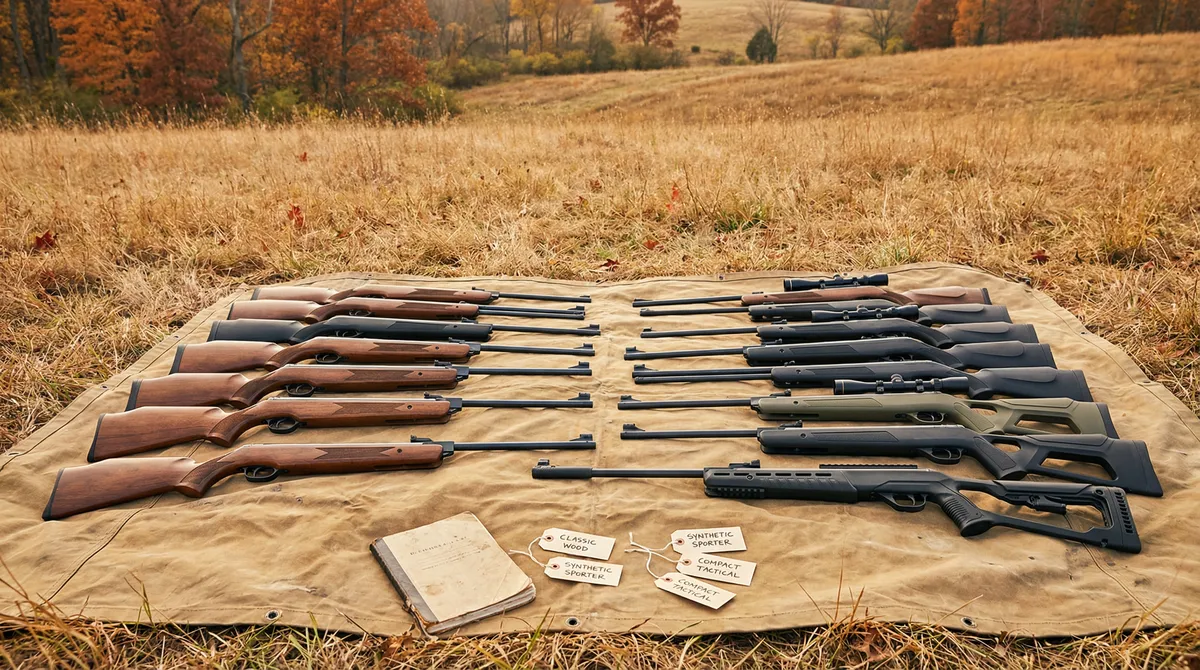
As an Amazon Associate, we earn from qualifying purchases. Buying through our links costs you nothing extra. Prices and availability are accurate as of the publication date.
A break barrel is the simplest way into pellet shooting. You snap the barrel down, that stroke compresses a spring or a gas piston, you drop a pellet in, snap it shut, and you’re loaded. No pump, no tank, no compressor, no CO2 cartridges to run out of on a Saturday afternoon. The gun is its own air supply, and it stays that way for as long as the powerplant lasts.
That simplicity is why most people’s first serious pellet rifle is a break barrel, and it’s also why the category is crowded with listings that all shout a big number and tell you almost nothing else. This guide works from the captured spec data on six rifles — caliber, quoted velocity, powerplant type, weight, what’s in the box — and lines them up so you can see where they actually differ. Where a maker only quotes a number one way, that’s said plainly, because a velocity with no pellet type attached is half a fact.
One thing worth setting straight before the list: the fps number on the box is a ceiling, not a promise. Makers quote it with the lightest pellet they can find, usually alloy, and the same rifle shooting a heavier lead pellet will read lower — and often group better. Pick the rifle for its caliber, weight, and trigger, and treat the headline velocity as a rough power class rather than a spec you’ll match in your backyard.
What a break barrel actually buys you
You get a rifle that works out of the box, forever, with nothing but pellets. That’s the whole pitch, and it’s a strong one. A PCP will out-shoot any of these on a bench, but a PCP needs a hand pump or a compressor and a tank before it fires a single shot, and that’s real money on top of the rifle. CO2 goes flat in cold weather. A break barrel just needs your arm.
What you give up is recoil behavior. A spring or gas piston slams forward when you pull the trigger, and the rifle jumps in two directions before the pellet leaves the muzzle. That’s why springers reward a loose, consistent hold instead of a death grip, and it’s why scopes built for recoiling powder rifles sometimes come apart on one. It’s a learnable quirk, not a flaw, but nobody mentions it in the listing.
The other honest tradeoff is the cocking stroke. Every shot costs you one full break of the barrel, so a magnum-class rifle in the 1,300 fps class asks more of your arm than a mid-power gun does. If you plan on long plinking sessions, that matters more than the last hundred feet per second.
Spring piston or gas piston — which one you want
A spring piston uses a coiled steel spring. It’s the older design, it’s cheap to build, and it’s easy to service. Leave one cocked for an hour and you’re compressing that spring the whole time, which is why the old advice is to cock it and shoot it, not cock it and wait.
A gas piston — Gamo calls its version IGT, Umarex calls its system 1-Stroke NTP — swaps the spring for a sealed cylinder of gas. Gamo says the IGT gives a smoother, easier cocking action with way less kick than a spring, and Umarex says its 1-Stroke NTP power system makes for smoother shooting. Both makers are describing the same general advantage in their own words. A gas piston also doesn’t mind sitting cocked, and it tends to shrug off cold weather better.
For most buyers the practical difference is feel, not power. Both types show up at the same velocity claims in this lineup. If you’re deciding between two otherwise similar rifles and one has a gas piston, that’s a reasonable tiebreaker — but it isn’t worth stretching your budget over.
Picking a caliber: .177 or .22
.177 is faster, flatter, and cheaper to feed. Pellets are everywhere and they cost less per tin. For paper targets, backyard plinking, and general practice, .177 makes the most sense — the flatter arc means small errors in your range estimate hurt less.
.22 throws a heavier pellet slower, and it dumps more of its energy into what it hits. That’s why the pest-control crowd leans that way. Diana gives a real number here that the others don’t: the Two-Sixty is quoted with 0.22 caliber lead pellets at a max power of 17.7 FPE. That FPE figure — foot-pounds of energy — is the honest way to compare hitting power across calibers, and it’s a shame more makers don’t print it, because it says more than fps ever will.
Three of these rifles are .177 and three are .22. Neither caliber is the beginner one. Pick based on what you’re shooting at, and check your state and local rules before you shoot anything live — air rifle law varies a lot by state and by city, and the box won’t tell you.
How to read a velocity claim without getting fooled
The single most misleading thing on an air rifle listing is a bare fps number. Here’s the tell: Umarex quotes the Prymex at up to 1200 FPS with alloy pellets and 1000 FPS with standard pellets. Same rifle, two different numbers, and the only thing that changed is the pellet.
That’s not Umarex being cagey. That’s Umarex being unusually straight with you, because most listings print only the alloy number and let you assume it applies to whatever you load. Gamo quotes the Wildcat Whisper at up to 1300 feet per second with alloy pellets and says so plainly. When a listing gives you a big number with no pellet type attached, assume it’s the alloy figure and mentally subtract.
Why does it matter? Alloy pellets are light, and light pellets go fast and hit soft. Most shooters end up on a mid-weight lead pellet because it groups better and carries more energy downrange, which means the number you’ll actually chronograph is well under the box number. That’s normal. A rifle isn’t underperforming because it doesn’t hit its own headline.
Noise, neighbors, and what a dampener really does
If you’re shooting in a backyard with houses nearby, muzzle noise is a legitimate buying criterion. Two rifles here address it directly. Gamo says the Wildcat Whisper has a built-in noise dampener right at the muzzle, cutting down on loud blasts, and calls it quiet enough for backyard plinking without annoying the neighbors. The Swarm Magnum 10X GEN3i carries what Gamo calls Whisper Fusion suppression, described as double noise dampeners that channel sound through two chambers.
Set expectations properly, though. A dampener works on the muzzle blast — the sound of compressed air escaping. It does nothing about the mechanical clack of the piston inside the rifle, and it does nothing about the crack a pellet makes if it goes supersonic, which a light alloy pellet in a magnum .177 can absolutely do. Loading heavier pellets to stay subsonic often does more for perceived noise than any dampener.
So: quieter than the same rifle without one, yes. Silent, no. And the pellet still makes a solid thwack when it hits the trap, which is usually the sound the neighbors notice anyway.
What weight tells you about how a rifle handles
Weight is the spec buyers skip and then regret. It’s the difference between a rifle a kid can hold steady and one that wears out your arms in twenty minutes — and it’s usually the most honest number on the page, because there’s no marketing angle in it.
The spread in this lineup is real. Umarex lists the Prymex at 4 pounds. The Gamo Varmint is listed at 5.47 pounds and the Wildcat Whisper at 5.64 pounds. The Swarm Magnum 10X GEN3i is listed at 6.88 pounds, which is nearly three pounds over the Prymex — you feel that immediately when you shoulder it, and you feel it more after fifty shots.
Heavier isn’t automatically worse. Mass soaks up recoil and steadies a hold, which is part of why magnum rifles run heavy. But if the shooter is small, or the rifle is going to be carried around a property rather than shot off a bench, the lighter gun gets used more. A rifle that stays in the closet doesn’t shoot well no matter what the box says.
Length matters the same way. Gamo lists the Varmint at 43.3 inches and the Wildcat Whisper at 48 inches. That’s nearly five inches of difference, and it shows up every time you swing the rifle in a tight spot or hand it to someone shorter.
About the scope that comes in the box
Four of these rifles include glass: the Gamo Varmint includes a 4x32 scope and mount, the Umarex Prymex comes with a 4x32 scope with rings, the Diana Two-Sixty includes a Diana 4x32 scope and rings, and the Gamo Wildcat Whisper comes with a Gamo 4x32 scope and mounts. That’s a fixed 4x magnification across the board — sensible for the ranges these rifles are meant for, and one less thing to buy on day one.
The thing to know is that spring and gas piston rifles are hard on scopes. The recoil pulse runs both directions, and glass built for powder rifles can get shaken loose. Makers know it: Gamo says the Wildcat Whisper’s scope is built to handle the kick from the gas piston, and on the Swarm Magnum 10X GEN3i, Gamo describes an 11mm rail with polymer supports that soak up almost all the recoil to keep the scope from getting knocked out of whack.
If you do replace the glass later, look for a scope rated for springer use and mounts with a positive stop — the recoil will walk an ordinary mount backward off the rail over time. That’s not a knock on any rifle here; it’s just how the category works.
One rifle in this group ships without a scope: the Lancer Tactical comes with adjustable fiber optic iron sights only. That’s not a downgrade if you like irons, and it’s not a hidden cost either — you just know going in.
The two features that quietly matter most
Trigger and safety. Neither one shows up in the headline, and both change how the rifle feels every single shot.
On triggers, the Umarex Prymex lists a two-stage adjustable trigger and the Diana Two-Sixty lists an adjustable trigger. Two-stage means there’s a light takeup before the wall, so you can find the break without guessing — it’s the difference between squeezing a shot and being surprised by one. An adjustable trigger of any kind is worth real money on a budget rifle, because a heavy, creepy trigger will out-ruin your groups faster than any velocity difference in this list.
Safeties split two ways. The Gamo Varmint lists a manual safety and an anti-beartrap mechanism; the Diana Two-Sixty lists an automatic safety. Manual means you decide when it’s on. Automatic means it sets itself when you cock the rifle and you push it off deliberately before each shot. Neither is wrong — but know which one you’re getting, because a shooter expecting the other kind is a shooter fumbling at the wrong moment.
The anti-beartrap deserves its own sentence. A break barrel with the barrel hinged open is a loaded spring waiting on a sear, and if that sear lets go with your hand in the breech, the barrel comes up hard. An anti-beartrap mechanism blocks exactly that. Whether or not your rifle has one, never load with your fingers in the path of a barrel that could swing shut.
Setting a budget that survives contact with reality
The rifle is the big line item, but it isn’t the only one. Budget for a tin or three of pellets in a couple of weights, because finding the pellet your barrel likes is the cheapest accuracy upgrade there is and no two rifles agree on the answer.
Budget for a proper pellet trap, too. A cardboard box packed with rags stops working sooner than you’d think, and a magnum-class rifle will punch through improvised backstops that handled a lower-powered gun fine. Whatever you shoot into, put something solid behind it.
Safety glasses, always. Pellets bounce back off hard surfaces more often than new shooters expect, and that’s true at every power level in this guide.
What you don’t need to budget for is an air supply, and that’s the whole reason to buy a break barrel in the first place. Compare that against a PCP, where the pump or compressor can cost as much as the rifle, and the value case gets clear fast.
Best Break Barrel Air Rifles
1. Gamo Varmint Breakbarrel .177 Caliber Pellet Air Rifle
The Varmint is the plainest rifle in this group, and that’s mostly a compliment. It’s a .177 spring-piston break barrel that Gamo quotes at 1250.00 ft/sec, and it comes with a 4x32 scope and mount so you’re not making a second purchase before you shoot.
The build is straightforward: a steel barrel with a fluted polymer jacket, and a synthetic Monte Carlo stock with dual raised cheekpieces. Those raised cheekpieces on both sides mean you get the same cheek weld shooting either way — useful if a left-handed shooter is going to use it too, and useful if you’re just not fussy about which side you shoulder. Synthetic means weather doesn’t ruin it, which matters if the rifle lives by the back door instead of in a case.
It lists a manual safety and an anti-beartrap mechanism. The anti-beartrap is the one I’d point out to a first-time buyer — it’s the feature guarding against the way break barrels actually hurt people.
At 5.47 pounds and 43.3 inches, it’s the shortest rifle here with a listed length and sits on the lighter end. That combination makes it easier to handle in a barn aisle or along a fence line than the longer magnums, and easier to hand to someone who isn’t a big person.
Note what Gamo doesn’t say: the velocity claim doesn’t name a pellet type. Read it as the optimistic number and expect less with lead.
Best for: A first serious break barrel — light, short, scope included, nothing exotic to learn.
Listed at $129.90 when this guide was last updated. Amazon pricing moves, so check the figure on the page before you buy.
2. Umarex Prymex Break Barrel .177 Caliber Pellet Gun Air Rifle
The Prymex is the honest one on the spec sheet, and the lightest rifle here. Umarex quotes velocities up to 1200 FPS with alloy pellets and 1000 FPS with standard pellets — both numbers, stated plainly, with the pellet type attached to each. That’s how a velocity claim ought to be written, and it tells you more about the rifle’s real-world behavior than any single big number on a competitor’s box.
It runs Umarex’s 1-Stroke NTP power system, which the company describes as delivering smoother shooting along with break-barrel dependability. It’s the gas-piston approach rather than a coiled spring, so it doesn’t mind sitting cocked and it doesn’t care much about cold.
Sights are covered twice over: a fiber optic front sight and adjustable rear sight for irons, plus a 4x32 scope with rings. Having both means you can shoot it the day it arrives and mount glass when you feel like it, or pull the scope off and still have usable sights — which is more flexibility than most rifles in this price neighborhood offer.
The trigger is where it separates itself. Umarex lists a two-stage adjustable trigger, and on a rifle this light that matters — a light gun magnifies every bit of trigger creep into wobble.
At 4 pounds it’s the easiest rifle here to hold up, carry, and hand to a smaller shooter. The stock is polymer and Umarex describes it as easy to grip.
Best for: Smaller or younger shooters, and anyone who wants both irons and glass without buying twice.
Listed at $109.99 when this guide was last updated. Amazon pricing moves, so check the figure on the page before you buy. Amazon is showing limited quantities on this one.
3. Diana Two-Sixty Breakbarrel .22 Caliber Air Rifle
The Two-Sixty is the one that tells you what it actually does. Diana quotes it shooting 0.22 caliber lead pellets with a max power of 17.7 FPE — an energy figure measured with lead, which is the one number in this whole guide you can compare across calibers honestly. It’s a single-shot break barrel spring piston, no magazine, no gas ram, nothing clever.
Don’t line that FPE figure up against the big fps claims elsewhere in this guide, because they’re two different measurements. Diana quotes with lead pellets rather than alloy, and this is a .22 rather than a .177 — a heavier pellet moving slower. Foot-pounds tells you what lands. Feet per second only tells you how fast it left.
The stock is a thumbhole design with a textured pistol grip and forearm and a rubber buttpad, plus an elevation-adjustable cheek piece. That cheek piece is the standout: it lets you raise your eye to meet the scope instead of craning your neck, and it’s the fix for the neck-strain problem almost every scoped break barrel has. The barrel is rifled and the trigger is adjustable.
Sighting options cover both bases — fiber optic front and rear sights, an 11mm dovetail optics rail, and an included Diana 4x32 scope and rings. It also lists an automatic safety, so it arms itself when you cock it.
One practical note: this listing carries an availability date rather than shipping right away, so check where it stands before you plan around it.
Best for: The .22 buyer who wants a real energy figure and a stock that adjusts to fit.
Listed at $99.99 when this guide was last updated. Amazon pricing moves, so check the figure on the page before you buy. Amazon lists this one for pre-order rather than immediate shipping.
4. Gamo Swarm Magnum 10X GEN3i Inertia Fed .22 Caliber Break Barrel air Rifle. High Power 10-Shot Pellet air Gun. 1,300 fps Velocity.
This is the one that fixes the most annoying thing about break barrels: reloading. The GEN3i magazine holds 10 shots and uses the rifle’s own recoil to load the next pellet, so you still break the barrel to cock it but you’re not fumbling a pellet into the breech every single time. Gamo says the third-gen magazine keeps a low profile on the barrel and makes sure each shot loads smoothly. If you’ve ever dropped a .22 pellet in wet grass and gone looking for it, you understand why this feature exists.
Power comes from the IGT Mach 1 gas piston running a 33mm cylinder, which Gamo says produces up to 1300 fps. It’s a .22, so that’s the big-number claim on a heavier pellet than the .177s here are quoting.
Gamo pairs that with Whisper Fusion suppression — double noise dampeners routing sound through two chambers — and an 11mm recoil-reducing rail using polymer supports that Gamo says soak up almost all the recoil to keep your scope from getting knocked out of whack. Those two features tell you what kind of rifle this is: a magnum trying hard not to behave like one.
The cost is weight. At 6.88 pounds it’s the heaviest rifle in this guide by well over a pound. Steady on a rest, tiring on a walk.
It’s also the most expensive of the six, and if the 10-shot magazine doesn’t excite you, that’s the feature you’re paying for.
Best for: Pest control and longer sessions where reloading one pellet at a time gets old fast.
Listed at $299.99 when this guide was last updated. Amazon pricing moves, so check the figure on the page before you buy. Amazon is showing limited quantities on this one.
5. Lancer Tactical Air Rifle 1000 FPS Break Barrel 0.22 Caliber Pellet Gun 5.5mm Hunting Spring Piston Air Rifle (Black)
The Lancer Tactical is the budget entry, and it’s honest about being simple. It’s a .22 spring piston break barrel with an all-steel barrel, quoted up to 1000 FPS. Lancer Tactical describes the barrel as fine-tuned for accuracy and the spring piston system as high-performance — maker’s language, worth exactly what maker’s language is usually worth, but the underlying setup is the proven one.
It ships with adjustable fiber optic iron sights and no scope. That’s the real difference between this and most of the others here, and it cuts both ways: iron sights are faster at close range and there’s nothing to shake loose, but if you want magnification you’re buying it separately, so factor that into what you’re really spending.
The stock is all-weather synthetic polymer in a black and camo finish, which is the right material choice for a rifle that lives outdoors. Lancer Tactical says the break design keeps operation simple and maintenance minimal, which is the whole appeal of this class.
The listing includes a safety note worth repeating: this is not an airsoft gun. It shoots .22 caliber lead pellets and it will do real damage. If you found it while shopping airsoft, stop and re-read that line — the safety rules are different and the backstop requirements are different.
What you don’t get is a specified trigger, a listed weight, or a stated safety type. That’s information missing from the listing, not a claim I’m making about the rifle either way.
Best for: The lowest-cost way into .22, if you’re fine on irons and don’t need a scope in the box.
Listed at $92.99 when this guide was last updated. Amazon pricing moves, so check the figure on the page before you buy.
6. Gamo Wildcat Whisper .177 Break Barrel Air Rifle- IGT Gas Piston
The Wildcat Whisper is aimed squarely at the backyard shooter with neighbors. Gamo says the barrel has a built-in noise dampener right at the tip that cuts down on loud blasts, and calls it quiet enough for backyard plinking without annoying the neighbors. That’s the pitch, and it’s a reasonable one — just remember a dampener works on muzzle blast, not on a supersonic pellet or the piston’s own clack.
Power is the IGT gas piston, which Gamo says pushes this .177 up to 1300 feet per second with alloy pellets — note that Gamo attaches the pellet type here, so you know what the number means. Gamo also says the gas piston gives a smooth, easy cocking action with way less kick than a spring, which is the practical argument for the design over a coiled spring.
The stock is ambidextrous and made from what Gamo describes as the same tough material used in European luxury cars, which is marketing prose for a durable synthetic — the useful part is that it’s ambidextrous and weather-proof. A Gamo 4x32 scope and mounts are included, and Gamo says the scope is built to handle the kick from the gas piston.
Size is the thing to check before you buy. At 48 inches it’s the longest rifle here, roughly five inches over the Varmint, and it weighs 5.64 pounds. That length steadies a hold on a bench and gets in your way in a shed doorway. Measure where you’ll actually use it.
Best for: Backyard plinking where noise is a real constraint and you want a gas piston.
Listed at $139.99 when this guide was last updated. Amazon pricing moves, so check the figure on the page before you buy.
Frequently Asked Questions
Do I need a license or permit to own an air rifle?
It depends entirely on where you live, and there’s no single answer for the US. Some states treat air rifles like any other outdoor tool, some regulate them close to firearms, and plenty of cities and counties have their own rules about discharging one inside city limits regardless of what the state says. Check your state law and your local ordinance before you buy, not after — and if you’re planning to hunt anything with one, check your state’s hunting regulations separately, since legal-to-own and legal-to-hunt-with are two different questions.
Why won’t my rifle hit the velocity on the box?
Because that number was measured with the lightest pellet the maker could find, usually alloy, and you’re almost certainly shooting lead. The Umarex Prymex spells the gap out: up to 1200 FPS with alloy pellets and 1000 FPS with standard pellets — same rifle, same barrel, and the only thing that changed is the pellet. Add a barrel that isn’t broken in yet and a chronograph that isn’t in the maker’s test lab, and a gap is normal. It’s not a defect, and chasing the box number with ultra-light pellets usually makes your groups worse, not better.
Spring piston or gas piston — does it actually matter?
For power, not much; both types hit similar velocity claims in this lineup. For feel and convenience, some. Gamo says its IGT gas piston gives a smooth, easy cocking action with way less kick than a spring, and Umarex says its 1-Stroke NTP system makes for smoother shooting. A gas piston also doesn’t mind being left cocked and generally handles cold better. If two rifles are otherwise close, take the gas piston. Don’t blow your budget over it.
How quiet is a ‘whisper’ or dampened air rifle really?
Quieter than the same rifle without one, and that’s the honest ceiling. A muzzle dampener works on escaping air. It does nothing about the mechanical noise of the piston inside the rifle, and nothing about the crack of a pellet going supersonic, which a light pellet in a magnum .177 can do. If noise is your main worry, a dampened rifle plus heavier pellets that stay subsonic will do more together than either alone. And the pellet hitting the trap still makes a noise — often the one the neighbors actually hear.
Should a beginner start with .177 or .22?
Start with what you’ll shoot at. If it’s paper, cans, and general practice, go .177 — flatter trajectory, cheaper pellets, more forgiving of range-estimate errors. If it’s pest control, go .22 for the heavier pellet and more energy on impact. Neither is harder to learn. Ignore anyone who tells you one caliber is the beginner one; the trigger and the weight of the rifle will affect your shooting far more than the caliber will.
Is the included scope any good, or should I plan to replace it?
The included 4x32 scopes are enough to shoot with on day one, which is the point — you’re not stuck waiting on a second order. Whether you outgrow one depends on how far you’re shooting and how picky you get. If you do replace it, buy a scope specifically rated for springer or gas-piston use, because the two-direction recoil of these rifles destroys glass built for powder rifles. Gamo says the Wildcat Whisper’s included scope is made to handle the kick from the gas piston, and on the Swarm Magnum 10X GEN3i the 11mm rail uses polymer supports to absorb recoil for the same reason. Those features exist because the problem is real.
What else do I need to buy besides the rifle?
Pellets in two or three weights, so you can find the one your barrel likes — that’s the cheapest accuracy improvement available to you. A real pellet trap, with something solid behind it, because a magnum rifle will punch through a backstop that handled a weaker gun fine. And safety glasses, every time, for you and anyone standing near you. Pellets bounce off hard surfaces more than new shooters expect. What you don’t need is an air supply, which is the entire reason to buy a break barrel instead of a PCP.
If you want the short version: the Umarex Prymex is the easiest rifle here to hold and shoot, the Diana Two-Sixty is the one whose numbers you can actually trust to mean something, the Gamo Swarm Magnum 10X GEN3i solves the reloading problem if you’re willing to carry the weight, and the Gamo Varmint and Wildcat Whisper are solid middle-of-the-road picks that differ mainly in length and noise. The Lancer Tactical is the cheapest door into .22 if you’re happy on irons.
Whatever you pick, buy a few pellet weights with it and give the rifle a couple of tins to settle in. The rifle that fits your arms and your trigger finger will out-shoot the one with the bigger number on the box, every time.
We earn a commission on purchases made through links on this page, at no cost to you. It doesn’t change what goes in a guide or what order things land in — the specs decide that.
Video reviews
Best Inexpensive Air Rifle for Adults (Over 20 Guns reviewed!) — Backfire
Best Budget Air Rifle: Gamo Swarm Whisper — Oh Shoot
Top 8 Best Break Barrel Air Rifles 2025 — TacticalGear