Last updated: December 2026
The PCP vs spring air rifle debate is one of the most important decisions you’ll make when buying an airgun. Both technologies have passionate supporters, and both can deliver excellent accuracy and power—but they’re fundamentally different in how they operate, what they cost, and who they’re best suited for.
Whether you’re a first-time buyer overwhelmed by options or an experienced springer shooter curious about PCP, this comprehensive guide breaks down everything you need to know about spring vs PCP air rifles in 2026. We’ll cover the technology, total cost of ownership, performance differences, and recommend the best rifles in each category to help you make the right choice.
Understanding the Technology: How Each System Works
How Spring-Piston Air Rifles Work
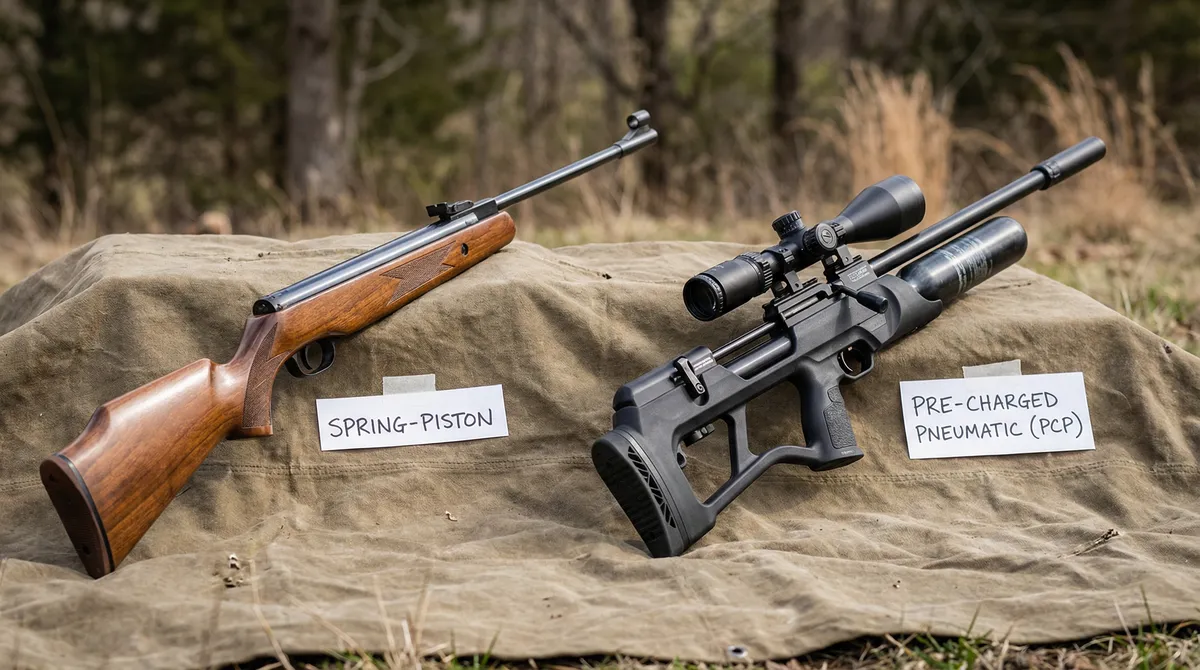
A spring air rifle (also called a “springer”) stores energy in a coiled steel spring or gas piston. When you cock the rifle—usually by breaking the barrel downward or operating an underlever—you compress this spring or gas unit. When you pull the trigger, the stored energy is released, driving a piston forward that compresses air behind the pellet and propels it down the barrel.
This is beautifully simple, self-contained technology. Your muscles provide the only power source needed. There are no tanks to fill, no cartridges to replace, and no external equipment required beyond the rifle itself and pellets.
How PCP Air Rifles Work
A PCP air rifle (Pre-Charged Pneumatic) operates on an entirely different principle. These rifles have an onboard air reservoir (typically a tube beneath or surrounding the barrel) that you fill with high-pressure air—usually 2,000-3,000 PSI. When you pull the trigger, a precisely metered amount of this compressed air is released behind the pellet.
Because the air is pre-compressed, the firing cycle is incredibly smooth—there’s no spring surging forward, no piston bouncing. The rifle simply releases air. This fundamental difference has profound implications for accuracy, shooting experience, and practical use.
PCP vs Spring Air Rifle: Head-to-Head Comparison
| Feature | Spring/Gas Piston | PCP |
|---|---|---|
| Initial Cost | $100-$700 | $250-$2,000+ |
| Additional Equipment Needed | None | Hand pump or tank ($50-$400) |
| Shots Per Fill/Cock | 1 | 20-60+ |
| Recoil | Significant (bidirectional) | Minimal to none |
| Ease of Accuracy | Requires technique mastery | Easy—point and shoot |
| Noise Level | Moderate to loud | Very quiet (most models) |
| Power Potential | Up to ~30 FPE | Up to 500+ FPE (big bore) |
| Portability | Excellent—completely self-contained | Limited by air supply |
| Maintenance | Minimal—occasional lube | O-ring service, more complexity |
| Scope Compatibility | Airgun-rated scopes only | Any quality scope works |
Spring Air Rifle: Pros and Cons
Advantages of Spring/Gas Piston Rifles
-
Complete Self-Sufficiency: No tanks, pumps, or external equipment needed. Take it anywhere, shoot anytime.
-
Lower Initial Investment: Quality springers start around $150-200, making them accessible for beginners.
-
Zero Ongoing Costs: Beyond pellets, there’s nothing to buy or refill.
-
Extreme Durability: Well-made springers can last decades with minimal maintenance.
-
Builds Shooting Fundamentals: The technique required teaches skills that transfer to all shooting disciplines.
-
Simple Mechanics: Fewer parts mean less that can go wrong in the field.
-
Weather Resistant: Springs perform consistently in cold weather (gas pistons may lose some velocity).
Disadvantages of Spring/Gas Piston Rifles
-
Challenging Shooting Technique: The artillery hold takes practice to master; poor technique = poor accuracy.
-
Bidirectional Recoil: The unique forward-then-backward recoil destroys non-airgun-rated scopes.
-
Single Shot Only: Must cock between each shot (though some models like the Gamo Swarm have magazines).
-
Physical Effort Required: Magnum springers require 40-50 lbs of cocking effort; not ideal for extended sessions.
-
Power Ceiling: Maximum practical power is around 30 FPE—not enough for larger game.
-
Louder Report: Generally noisier than suppressed PCP rifles.
-
Hold Sensitivity: Any change in how you hold the rifle affects point of impact.
PCP Air Rifle: Pros and Cons
Advantages of PCP Rifles
-
Inherent Accuracy: No recoil means the rifle doesn’t move during the shot—dramatically easier to shoot accurately.
-
Multi-Shot Capability: Most PCPs have rotary magazines holding 10+ pellets; rapid follow-up shots are easy.
-
Adjustable Power: Many PCPs let you dial power up or down for different applications.
-
Very Quiet: Shrouded barrels and built-in moderators make most PCPs whisper-quiet.
-
Higher Power Potential: From 12 FPE target rifles to 500+ FPE big bores, PCPs cover every application.
-
Any Scope Works: Without punishing recoil, even delicate precision scopes are safe.
-
Trigger Quality: PCP triggers can be incredibly light and crisp without affecting reliability.
-
Consistent Velocity: Regulated PCPs deliver the same velocity shot after shot.
Disadvantages of PCP Rifles
-
Higher Entry Cost: Need the rifle PLUS a filling device—budget $400-600 minimum to get started.
-
Dependent on Air Supply: When your tank is empty, you’re done shooting until you can refill.
-
More Complex: More parts, more seals, more potential failure points.
-
Maintenance Requirements: O-rings need periodic replacement; regulators need service.
-
Limited Portability: Extended field use requires carrying a hand pump or extra tanks.
-
Steep Learning Curve for Equipment: Understanding fill pressures, regulators, and shot counts takes time.
Total Cost of Ownership Analysis
One of the biggest misconceptions about the PCP air rifle vs springer decision is focusing only on rifle price. Here’s what each platform actually costs to own:
Spring Air Rifle: True Cost
| Item | Cost |
|---|---|
| Quality Spring Rifle (e.g., Hatsan 95) | $200 |
| Airgun-Rated Scope | $75-150 |
| Quality Mounts | $30-50 |
| Fill Equipment | $0 |
| Total to Start Shooting | $305-400 |
PCP Air Rifle: True Cost
| Item | Cost |
|---|---|
| Quality PCP Rifle (e.g., Air Venturi Avenger) | $350 |
| Scope (standard rifle scope OK) | $75-150 |
| Hand Pump | $50-80 |
| OR Carbon Fiber Tank | $250-400 |
| Fill Adapter/Hose | $30-50 |
| Total to Start Shooting (with pump) | $505-630 |
| Total to Start Shooting (with tank) | $705-950 |
Important Note on Fill Options
A hand pump works but requires significant physical effort (300+ pumps per fill). Most serious PCP shooters eventually invest in a carbon fiber tank that they get filled at a scuba shop or paintball store for $5-10 per fill. The tank provides dozens of rifle fills and makes the shooting experience much more convenient.
Best Use Cases: When to Choose Each Type
Choose a Spring Air Rifle If You:
-
Want maximum simplicity with no support equipment
-
Are on a tight budget (under $400 total)
-
Plan to shoot in remote areas far from fill sources
-
Enjoy the challenge of mastering hold-sensitive rifles
-
Want a “grab and go” rifle that’s always ready
-
Primarily plink or hunt small pests at closer ranges
-
Value low ongoing costs over shooting convenience
Choose a PCP Air Rifle If You:
-
Prioritize accuracy and ease of shooting
-
Want to take rapid follow-up shots
-
Need quiet operation for backyard or pest control use
-
Plan to hunt small game seriously and need consistent accuracy
-
Want maximum power potential (big bore hunting)
-
Shoot competitively where consistency matters
-
Have physical limitations that make cocking springers difficult
-
Don’t mind the initial investment for long-term convenience
Use Case Breakdown: Hunting, Target, and Plinking
For Hunting
Winner: PCP
For serious small game hunting, PCP rifles have significant advantages. The ability to take a quick follow-up shot if needed, whisper-quiet operation that doesn’t spook other game, and inherent accuracy that makes ethical shots easier all favor PCP. The lack of cocking motion between shots is also valuable when hunting from blinds or hides.
That said, quality springers like the Hatsan 95 are perfectly capable hunting tools for shooters who’ve mastered the technique. Many hunters appreciate that a springer is always ready—no worrying about air supply on extended hunts.
For Target Shooting
Winner: PCP
When pure accuracy matters, PCP dominates. The smooth, recoilless firing cycle makes consistent shot placement far easier. This is why virtually all competitive field target and benchrest shooters use PCP rifles. The ability to shoot many pellets quickly also makes practice sessions more productive.
However, 10-meter precision shooting still sees spring rifles in competition classes, and mastering a springer can actually make you a better overall shooter by forcing excellent technique.
For Backyard Plinking
Winner: Tie (depends on priorities)
For casual plinking, both platforms work well. Springers offer grab-and-go convenience—no prep time, no fill equipment to set up. PCPs offer more shots per session and quieter operation (important for noise-sensitive neighborhoods).
If you’re plinking for skill development, a springer will build better fundamentals. If you’re plinking purely for fun and want maximum rounds downrange with minimum effort, PCP wins.
Our Top Picks: Best Spring and PCP Air Rifles
Best Entry-Level Spring Air Rifle: Hatsan 95
The Hatsan 95 delivers exceptional value with its adjustable Quattro trigger, quality Turkish walnut stock, and solid accuracy potential. Available in .177, .22, and .25 calibers, it’s versatile enough for everything from plinking to pest control. The moderate power level (around 17 FPE in .22) keeps cocking effort manageable while still providing enough energy for practical use.
Key Specs: .177/.22/.25 caliber | ~800 FPS (.22) | ~30 lb cocking effort | Adjustable trigger
Best Magnum Spring Air Rifle: Gamo Swarm Magnum 10X Gen 3i
The Gamo Swarm Magnum 10X Gen 3i combines serious magnum power with an innovative 10-shot magazine system that eliminates the biggest springer limitation. The gas piston powerplant delivers up to 33 FPE in .22 caliber—enough for serious pest control and small game. The Gen 3i improvements make for a smoother shooting experience than earlier versions.
Key Specs: .177/.22 caliber | 975 FPS (.22) | Gas piston | 10-shot magazine | Includes scope
Best Value PCP Air Rifle: Air Venturi Avenger
The Air Venturi Avenger is the rifle that brought premium PCP features to budget-friendly prices. It includes a regulator (for consistent velocity), adjustable power, adjustable hammer spring, and a smooth sidelever action—features previously found only on $800+ rifles. The synthetic stock is functional if not fancy, and accuracy is genuinely impressive for the price.
Key Specs: .177/.22/.25 caliber | Regulated | Adjustable power | 2-stage adjustable trigger | ~60 shots per fill (.22)
Best Premium PCP Air Rifle: Benjamin Marauder
The Benjamin Marauder has been the benchmark mid-range PCP for over a decade, and current production models continue that legacy. It’s whisper-quiet thanks to its fully shrouded barrel, remarkably accurate, and built with the fit and finish of rifles costing much more. The wood stock version adds classic aesthetics to the already impressive package.
Key Specs: .177/.22/.25 caliber | Shrouded barrel | Adjustable 2-stage trigger | ~32 shots per fill (.22) | Reversible bolt
Quick Comparison: Our Recommended Rifles
| Model | Type | Best For | Price Range | Buy |
|---|---|---|---|---|
| Hatsan 95 | Spring | Budget springer, beginners | ~$200 | Amazon |
| Gamo Swarm Magnum 10X | Gas Piston | Hunting, max springer power | ~$250 | Amazon |
| Air Venturi Avenger | PCP | Best value PCP, all-around | ~$350 | Amazon |
| Benjamin Marauder | PCP | Quiet shooting, accuracy | ~$500 | Amazon |
Making Your Decision: Our Recommendations
For First-Time Air Rifle Buyers
If this is your first air rifle and budget is a concern, start with a quality springer like the Hatsan 95. You’ll learn important shooting fundamentals, have no additional equipment to buy, and can always add a PCP later if you want. Many experienced airgunners own both types for different applications.
For Buyers Who Prioritize Accuracy and Convenience
If you can invest in the fill equipment and want the easiest path to accurate shooting, go directly to PCP. The Air Venturi Avenger offers premium features at an entry-level price, making it the best value in PCP air rifles today. Add a hand pump to start, and upgrade to a tank when budget allows.
Check Air Venturi Avenger Price
For Hunters and Serious Shooters
If you plan to hunt small game seriously or want the quietest possible operation, the Benjamin Marauder is worth the investment. Its legendary quiet operation, excellent accuracy, and proven reliability make it a favorite among hunters and pest controllers. Pair it with a carbon fiber tank for hassle-free extended shooting sessions.
Related Guides on PelletGuns101
Dive deeper into air rifle selection with these related guides:
-
Best Air Rifle Scopes Guide
Final Thoughts
The PCP vs spring air rifle debate doesn’t have a universal winner—both technologies have earned their place in the airgun world for good reasons. Springers offer unmatched simplicity, lower costs, and complete independence from support equipment. PCPs deliver easier accuracy, multi-shot convenience, and the quiet operation that modern airgunners increasingly demand.
For most shooters, the honest answer is that you’ll eventually want one of each. A springer for grab-and-go convenience and building fundamentals, and a PCP for when accuracy and shot volume matter most. Start with whichever platform best fits your current needs and budget, and know that neither choice is wrong—just different.
Whatever you choose, the best air rifle is the one that gets you out shooting. Both platforms deliver genuine accuracy, real-world power for pest control and small game, and the satisfaction of mastering a precision tool. Happy shooting!
Disclosure: PelletGuns101.com is a participant in the Amazon Services LLC Associates Program, an affiliate advertising program designed to provide a means for sites to earn advertising fees by advertising and linking to Amazon.com. When you purchase through our links, we may earn a small commission at no additional cost to you. This helps support our site and allows us to continue providing free airgun content and reviews.