Last updated: November 2026
Walk into any sporting goods store or browse any airgun website, and you’ll see air rifle fps numbers plastered everywhere: “1,400 FPS!” “Blazing 1,500 FPS Velocity!” It’s the biggest number on the box, and manufacturers know it sells guns. But here’s what they don’t tell you: FPS alone means almost nothing when evaluating an air rifle’s actual performance.
Understanding the relationship between pellet gun fps, pellet weight, and air rifle foot pounds of energy is crucial for choosing the right airgun for your needs. Whether you’re hunting, pest control, or target shooting, this guide cuts through the marketing hype and explains what actually matters when evaluating airgun power.
What is FPS and Why Do Manufacturers Advertise It?
FPS stands for “feet per second”—a measurement of how fast a projectile travels when it leaves the barrel. It’s a simple, easy-to-understand number that sounds impressive when it’s high. A rifle advertised at 1,400 FPS sounds dramatically more powerful than one rated at 900 FPS, right?
Not necessarily. Here’s the dirty secret of airgun marketing: those headline FPS numbers are almost always measured with ultra-lightweight alloy pellets that no serious shooter actually uses.
Manufacturers test with the lightest possible pellets (often 5-7 grain alloy pellets in .177 caliber) specifically because lighter projectiles travel faster. It’s physics: the same amount of energy accelerates a lighter object to higher velocity. These lightweight alloy pellets are typically unsuitable for anything beyond close-range plinking—they’re inaccurate, unstable in wind, and carry very little energy to the target.
When you load quality lead pellets weighing 8-10 grains (or heavier hunting pellets at 13-16 grains), that “1,400 FPS” rifle suddenly shoots 850-1,000 FPS. Still plenty fast, but a very different story than the box suggests.
Why Energy (FPE) Matters More Than Velocity (FPS)
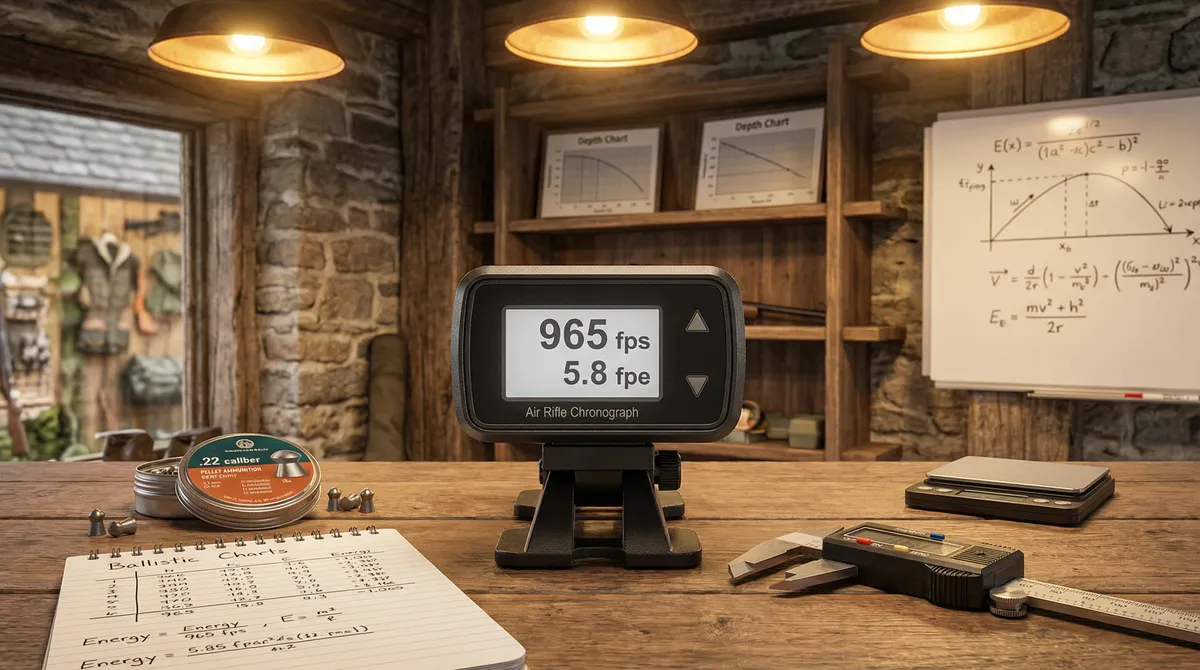
The number that actually tells you what an air rifle can do is foot-pounds of energy (FPE), sometimes called “fpe air rifle” or muzzle energy. This measurement accounts for both velocity AND projectile weight, giving you the true picture of downrange performance.
The formula is simple:
FPE = (Velocity² × Pellet Weight) ÷ 450,240
Where velocity is in FPS and pellet weight is in grains
Let’s see how this works in practice with two very different pellets from the same rifle:
Example: Same Rifle, Different Pellets
| Pellet Type | Weight | Velocity (FPS) | Energy (FPE) |
|---|---|---|---|
| Lightweight Alloy | 5.4 gr | 1,400 FPS | 23.5 FPE |
| Standard Lead (JSB Exact) | 8.4 gr | 1,050 FPS | 20.6 FPE |
| Heavy Hunting (H&N Baracuda) | 10.6 gr | 920 FPS | 19.9 FPE |
Notice something interesting? Despite the dramatic 480 FPS difference between the alloy and heavy lead pellets, the actual energy difference is only about 3.5 FPE. The heavier pellets’ mass compensates for their slower velocity.
And here’s the kicker: those slower, heavier pellets will actually deliver MORE energy to the target at typical hunting distances because they retain velocity better through the air. The lightweight alloy pellet sheds velocity rapidly due to its poor ballistic coefficient.
How Pellet Weight Affects Performance
Choosing the right pellet weight involves balancing several factors. Here’s what changes as you move up or down the weight spectrum:
Lighter Pellets (5-8 grains in .177)
-
Higher velocity
-
Flatter trajectory at close range
-
More affected by wind
-
Lose velocity quickly downrange
-
Less penetration on impact
-
Generally less accurate in most rifles
Heavier Pellets (10-16+ grains in .177)
-
Lower muzzle velocity
-
More curved trajectory
-
Better wind resistance
-
Retain velocity/energy better at distance
-
Better penetration for hunting
-
Often more accurate (rifle dependent)
For most applications, medium-weight quality lead pellets in the 8-10 grain range (.177) or 14-16 grain range (.22) offer the best balance of trajectory, accuracy, and terminal performance. Save the lightweight alloys for close-range plinking where their limitations don’t matter.
What FPS/FPE Do You Actually Need?
This is where understanding air rifle foot pounds becomes practically important. Different activities have different energy requirements, and choosing a rifle that matches your intended use prevents both disappointment and overkill.
FPS and Energy Requirements by Activity
| Activity | Minimum FPE | Recommended FPE | Notes |
|---|---|---|---|
| Indoor Target/10m | 3-5 | 5-8 | More power unnecessary; quiet matters more |
| Backyard Plinking | 5-8 | 8-15 | Balance of power and pellet cost |
| Field Target (Competition) | 10-12 | 11-12 | Most competitions cap at 12 FPE |
| Sparrows/Starlings | 5-8 | 8-12 | Shot placement critical |
| Squirrels/Rabbits | 12 | 15-25 | .22 caliber preferred |
| Raccoons/Large Pests | 25-30 | 30-50 | .22 or .25 caliber; headshots essential |
| Coyotes/Foxes | 50-60 | 75-100 | .25-.30 caliber; big bore territory |
Important Note on Hunting
These energy figures represent minimum requirements at point of impact, not muzzle energy. Air rifle projectiles lose energy faster than firearm bullets, so a rifle producing 25 FPE at the muzzle might only deliver 18 FPE at 40 yards. Always verify your specific rifle and pellet combination’s downrange performance before hunting.
The Marketing vs. Reality Gap
Let’s expose some common marketing tactics you’ll encounter when shopping for air rifles:
“Up to 1,400 FPS!”
Reality: This velocity is only achievable with ultralight alloy pellets that are impractical for most uses. Expect 850-1,000 FPS with quality lead pellets. The rifle is still perfectly capable—the marketing is just misleading.
“More Power Than Ever!”
Reality: Check the actual FPE specifications, not just FPS. A “magnum” rifle shooting lightweight pellets at 1,300 FPS might produce less useful energy than a moderate rifle shooting heavy pellets at 900 FPS.
“Perfect for Hunting”
Reality: Define “hunting.” A rifle with 15 FPE is suitable for small pests and with good shot placement, small game. It’s not appropriate for raccoons, foxes, or anything larger regardless of what the marketing suggests. Match your rifle’s actual energy output to your intended quarry.
Velocity-Based “Power Ratings”
Reality: Some manufacturers create arbitrary “power” ratings based solely on maximum velocity. Ignore these entirely. The only numbers that matter are actual FPE measured with the pellets you’ll actually shoot.
Velocity Considerations for Accuracy
Here’s something most pellet gun fps discussions miss: there’s an optimal velocity range for accuracy, and faster isn’t always better.
The Sound Barrier Problem
When a pellet crosses the sound barrier, it creates a small sonic crack and experiences destabilizing turbulence. Most diabolo pellets (the traditional waisted shape) are not designed for supersonic flight and often become unstable above 1,000-1,050 FPS.
This is why many experienced airgunners prefer rifles producing 850-950 FPS with their chosen pellet—fast enough for flat trajectory but subsonic for optimal stability. Premium target rifles like the Weihrauch HW97K are deliberately tuned to this velocity range, prioritizing accuracy over impressive FPS numbers.
The Accuracy Sweet Spot
For most spring/gas piston and PCP air rifles shooting diabolo pellets:
-
.177 caliber: 750-950 FPS optimal for accuracy
-
.22 caliber: 650-850 FPS optimal for accuracy
-
.25 caliber: 550-750 FPS optimal for accuracy
Slugs (solid projectiles designed like firearm bullets) can be accurate at higher velocities, but require rifles specifically designed for slug shooting—typically high-powered PCPs with appropriate twist rates.
Comparing Power Across Calibers
The same FPE can be achieved with different velocity/weight combinations across calibers. Here’s how typical air rifle calibers compare at similar energy levels:
| Caliber | Typical Pellet Weight | Velocity for ~15 FPE | Trajectory | Best For |
|---|---|---|---|---|
| .177 | 8.4 gr | ~895 FPS | Flattest | Target, plinking |
| .22 | 14.3 gr | ~687 FPS | Moderate | All-around, hunting |
| .25 | 25.4 gr | ~515 FPS | Most curved | Hunting, pest control |
At equal energy levels, the larger caliber’s heavier projectile will penetrate better and create a larger wound channel—both advantages for hunting. The smaller caliber’s higher velocity produces a flatter trajectory—an advantage for target shooting and situations where range estimation is difficult.
How to Evaluate Air Rifle Power Honestly
When shopping for your next air rifle, follow these steps to cut through the marketing and understand true performance:
-
Ignore headline FPS claims — They’re measured with impractical pellets
-
Find FPE specifications — Look for foot-pound energy ratings, ideally measured with lead pellets
-
Check independent reviews — Reviewers who chronograph rifles with real-world pellets provide the most useful data
-
Match energy to your needs — Use the table above to ensure the rifle meets your requirements
-
Consider caliber — Choose based on your intended use, not just power numbers
-
Test with your pellets — If possible, chronograph your chosen rifle/pellet combination to verify real-world performance
Related Guides on PelletGuns101
Continue learning about air rifles with these related guides:
-
Best Air Rifle Scopes Guide
The Bottom Line: FPS vs. FPE
When evaluating any air rifle’s power, remember these key points:
Key Takeaways
-
FPS is a marketing number — It tells you velocity with impractical pellets, not real-world performance
-
FPE (foot-pounds of energy) is what matters — It accounts for both velocity AND pellet weight
-
Heavier pellets often outperform lighter ones — Better accuracy, wind resistance, and penetration
-
Match power to purpose — More FPE isn’t always better; choose appropriately for your intended use
-
Velocity affects accuracy — Staying subsonic (under ~1,050 FPS) usually improves precision
-
Caliber matters as much as power — Larger calibers hit harder at equal energy levels
The next time you see an air rifle advertised at 1,400 FPS, you’ll know to ask the right question: “What’s the foot-pound energy with real pellets?” That single number tells you more about the rifle’s actual capability than any velocity claim ever could.
Don’t chase FPS numbers—chase performance that matches your needs. Whether that’s a 12 FPE target rifle that puts pellet after pellet through the same hole, or a 300 FPE big bore that ethically harvests deer, the right air rifle is the one that delivers appropriate energy for your intended application.
Happy shooting!
Disclosure: PelletGuns101.com is a participant in the Amazon Services LLC Associates Program, an affiliate advertising program designed to provide a means for sites to earn advertising fees by advertising and linking to Amazon.com. When you purchase through our links, we may earn a small commission at no additional cost to you. This helps support our site and allows us to continue providing free airgun content and reviews.